
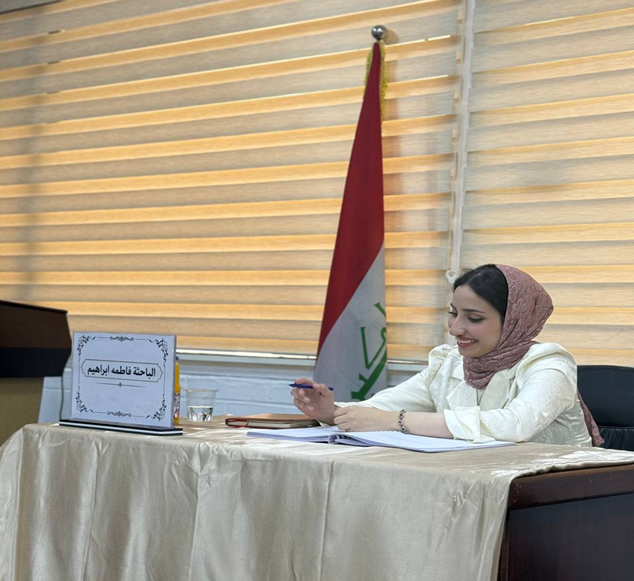
The Department of Petroleum Engineering at the College of Engineering, University of Baghdad, held the public defense of the master’s thesis submitted by researcher Fatima Ibrahim Nayef, entitled “An Experimental Study on the Effects of Carbon Dioxide Injection on the Petrophysical Properties and Chemical Composition of Carbonate Rocks.” The defense took place on Monday, September 7, 2026, in the department’s postgraduate studies hall, under the supervision of Prof. Dr. Mohammed Saleh Al-Jawad.
The examining committee consisted of:
- Prof. Dr. Iyad Abdul-Halim Abdul-Razzaq — Chair
- Assist. Prof. Dr. Dalia Abdul-Hadi Abdul-Latif — Member
- Dr. Ali Mohammed Hamoud, Expert — Member
- Prof. Dr. Mohammed Saleh Al-Jawad — Supervisor and Member
Thesis Summary
The thesis aimed to experimentally investigate the effects of carbon dioxide (CO₂) injection on the petrophysical properties and chemical composition of carbonate rocks. The study examined changes in porosity, permeability, chemical composition, and fluid properties resulting from interactions between the rocks and CO₂-saturated water. Rock samples from the Mishrif Formation in the Nasiriyah Oil Field in southern Iraq were used, along with actual formation water.
The research employed two experimental methods: static soaking and core flooding, to compare the effects of prolonged contact with CO₂-saturated water under static conditions with those resulting from the continuous flow of the water through rock samples.
In the static soaking experiments, the samples were exposed to CO₂-saturated formation water under high pressure, and changes were monitored over periods of up to three weeks. In the core flooding experiments, CO₂-saturated water was injected through the rock samples at a rate of 5 pore volumes per day (PV/day) for seven days, allowing the effects of fluid movement and continuous rock–fluid interactions to be investigated.
The experimental measurements included porosity and permeability, density and viscosity, pressure drop during injection, calcium and magnesium concentrations measured using inductively coupled plasma optical emission spectrometry (ICP-OES), and changes in pH.
The static soaking results revealed increased calcium and magnesium concentrations in the solution, indicating chemical interactions between the water and the rocks, particularly mineral dissolution. Changes in porosity and fluid properties were also observed, demonstrating the influence of geochemical reactions on the petrophysical properties of carbonate rocks.
The core flooding results showed varying responses among the samples, including different degrees of permeability enhancement. Changes in porosity, ion concentrations, and fluid properties also varied from one sample to another. These findings indicate that the response of carbonate rocks to CO₂-saturated water injection depends on the initial characteristics of the samples, the nature of the chemical reactions, and the dynamics of fluid flow through the rock.
The study highlights the importance of combining petrophysical measurements with chemical analyses to understand the changes resulting from interactions among carbon dioxide, water, and carbonate rocks. It also emphasizes the need to distinguish between static soaking and core flooding results when interpreting rock behavior.
Key Findings
- Core flooding experiments demonstrated improvements in permeability across the studied samples, although the magnitude of change varied from one sample to another.
- The core flooding experiments revealed that changes in petrophysical and chemical properties were not uniform across the samples, reflecting differences in rock characteristics and their responses to fluid flow and associated chemical reactions.
- Static soaking experiments revealed changes in porosity, calcium and magnesium concentrations, and fluid properties, supporting the occurrence of dissolution and geochemical reactions between the water and carbonate rocks.
Following the scientific discussion, the researcher’s responses to the committee’s questions, and the evaluation of the thesis by the examining committee, the researcher was awarded a Master’s degree in Petroleum Engineering.


