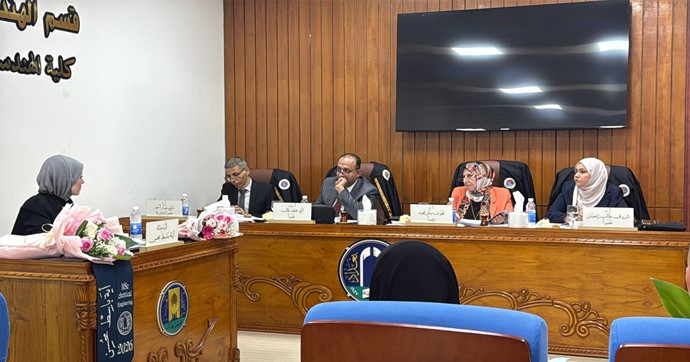
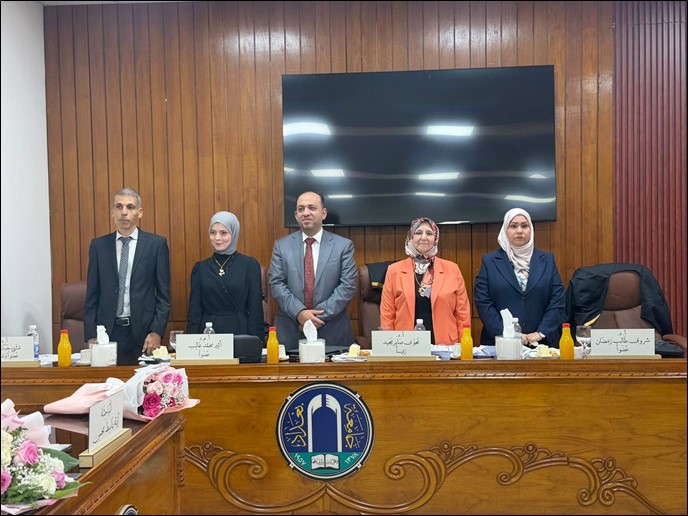
The College of Engineering at the University of Baghdad witnessed the public defense of the master’s thesis by Aya Basit Mohsin in the Department of Chemical Engineering. Her thesis, titled “Chitosan-based Materials as Adsorbents for The Enhanced Remediation of Cationic Synthetic Dyes,” was presented on Thursday, 10 September 2026, in Professor Mahmoud Omar Hall within the Department of Chemical Engineering, under the supervision of Prof. Dr. Muthana Jabar Ahmed.
The study addressed synthetic dyes as persistent and hazardous pollutants discharged in textile and related industrial wastewaters, particularly the cationic dyes crystal violet (CV) and methylene blue (MB). It aimed to develop low-cost, environmentally friendly chitosan-based adsorbents, enhance dye binding by introducing anionic surface sites, identify the most effective surfactant modification, and evaluate adsorption behavior and reusability.
Chitosan hydrogel beads were modified with three anionic surfactants: sodium dodecyl sulfonate (SDOS), sodium dodecyl sulfate (SDS), and sodium dodecylbenzene sulfonate (SDBS), producing CS/SDOS, CS/SDS, and CS/SDBS. The prepared materials were characterized using FTIR, FESEM, and BET analysis.
Batch adsorption experiments examined surfactant concentration, solution pH (2-12), contact time (0-1440 min), and initial dye concentration (50-550 mg/L) at 25 °C using 0.02 g of adsorbent in 40 mL of solution. The best surfactant concentration for all three surfactants was 3 g/L. Equilibrium data were analyzed using the Langmuir, Freundlich, and Sips models, while kinetic data were analyzed using the pseudo-first-order and pseudo-second-order models.
The results showed that anionic surfactant modification enhanced adsorption of both dyes. Adsorption performance followed the order CS/SDOS > CS/SDS > CS/SDBS, and CS/SDOS was therefore selected for the regeneration study. The highest adsorption was observed at approximately pH 6. The pseudo-second-order model provided the best representation of the kinetic data for both dyes, while the Sips model best described the equilibrium data.
The maximum experimental adsorption capacities of CS/SDOS reached approximately 614 mg/g for crystal violet and 414 mg/g for methylene blue. Reusability was evaluated over five adsorption-desorption cycles using 0.1 M HCl, with removal efficiency decreasing from 98% to 20% for crystal violet and from 95% to 21% for methylene blue after repeated regeneration.
The examining committee recommended further studies on adsorbent dosage, different temperatures to determine the adsorption thermodynamic parameters (ΔH, ΔS, and ΔG), ionic strength, and the use of an intra-particle diffusion model to identify the rate-controlling factor. The committee also recommended evaluating the prepared adsorbents using real textile wastewater containing mixtures of dyes, competing ions, and natural organic matter.
The committee further recommended continuous-flow adsorption studies using fixed-bed columns to evaluate dynamic adsorption behavior and suitability for large-scale wastewater treatment, together with an economic assessment of the process. Additional recommendations included improving regeneration by comparing acidic and alkaline regenerating agents at different concentrations, and enhancing the long-term stability of the modified chitosan beads through crosslinking agents or alternative surfactant immobilization methods during repeated adsorption-desorption cycles.