
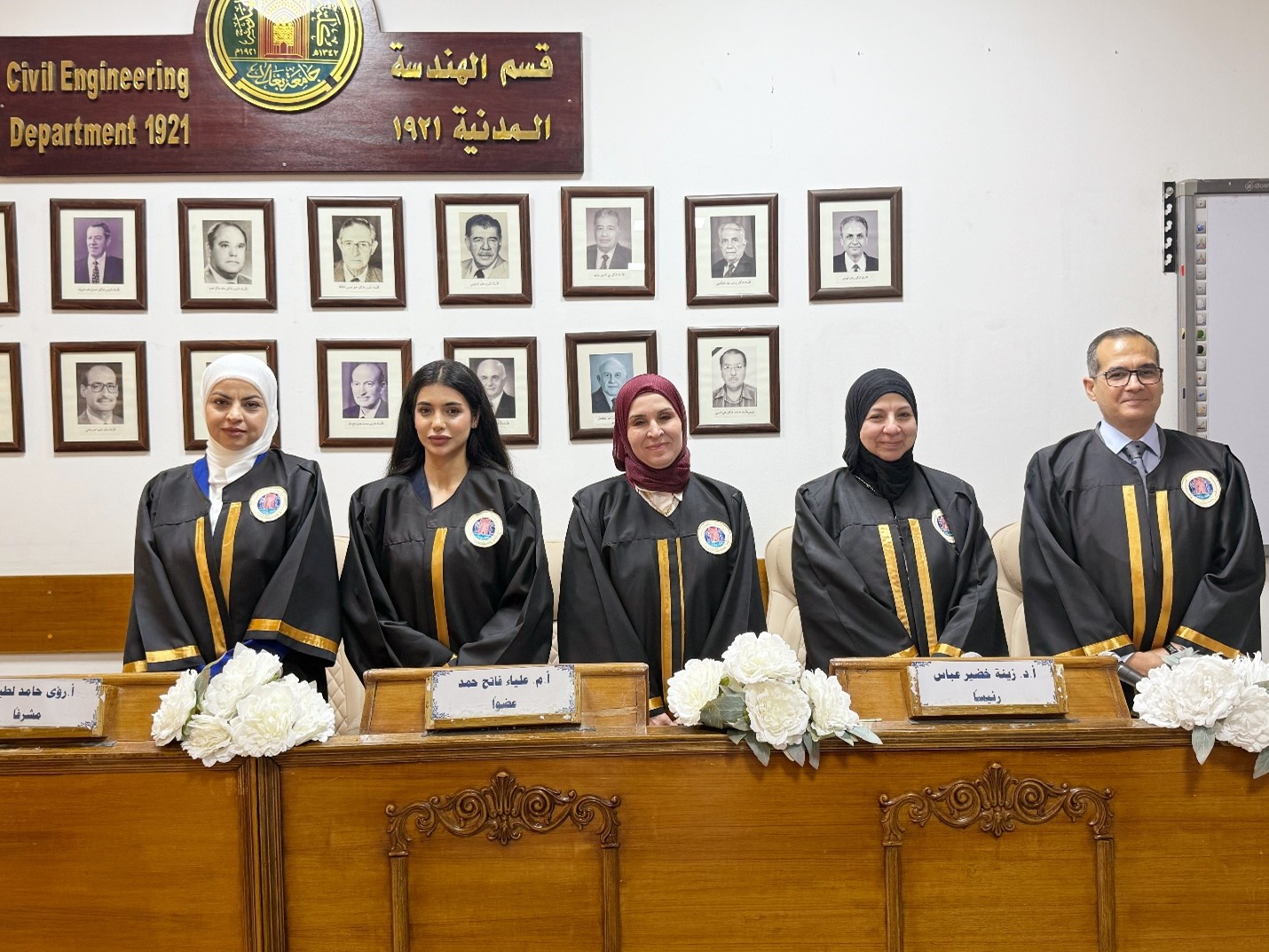
The College of Engineering at the University of Baghdad held the public defense of the Master’s thesis submitted by researcher Sundus Iyad Imad from the Department of Civil Engineering, entitled “Evaluation of Hot Mix Asphalt Properties Using Asphalt Modified with Styrene–Butadiene–Styrene and Polyethylene Glycol.” The defense was held on Thursday, August 27, 2026, at the Dr. Khalid Shakir Hall, under the supervision of Assist. Prof. Ruaa Hamid Latif.
The study investigated the modification of 40/50 penetration-grade asphalt binder using Styrene–Butadiene–Styrene (SBS) and Polyethylene Glycol (PEG) polymers. SBS was added at concentrations of 2%, 3%, and 4% by weight of the binder, while PEG was added at concentrations of 1.5%, 2.5%, and 3.5%. Three hybrid mixtures were also prepared by combining the corresponding proportions: Mix1, consisting of 2% SBS and 1.5% PEG; Mix2, consisting of 3% SBS and 2.5% PEG; and Mix3, consisting of 4% SBS and 3.5% PEG, using a high-shear wet mixing process.
The experimental program included two interconnected levels of evaluation. The binder characterization involved penetration, softening point, ductility, rotational viscosity, storage stability, Fourier Transform Infrared Spectroscopy (FTIR), and Scanning Electron Microscopy (SEM) tests. Meanwhile, the performance of the asphalt mixtures was evaluated through Marshall stability, indirect tensile strength, Cantabro abrasion, and rutting tests using the wheel-tracking method.
The results demonstrated significant improvements in the physical and rheological properties of the modified asphalt binder. The hybrid Mix3 achieved the best binder-level performance, recording the lowest penetration value of 29 tenths of a millimeter and the highest softening point of 60.2°C. FTIR analysis confirmed that the modification mechanism was predominantly physical, while SEM images revealed improved homogeneity in the microstructure of the hybrid system.
At the asphalt mixture level, the combined SBS–PEG modification resulted in a clear improvement in mechanical performance. Mix3 increased Marshall stability from 9.3 to 15.6 kN, raised the indirect tensile strength ratio from 82.6% to 92.6%, reduced dry abrasion loss in the Cantabro test from 7.75% to 5.99%, and decreased rut depth from 4.49 to 1.44 mm.
Although the mixture modified with 4% SBS alone demonstrated slightly higher rutting resistance, the Mix3 hybrid system achieved the best overall balance across the various performance indicators. The study therefore concluded that the combined SBS–PEG modification represents the most effective strategy for improving asphalt binder properties and ensuring the long-term durability of hot mix asphalt under high-temperature and moisture-exposure conditions.
Following the scientific discussion by the members of the examination committee, the researcher’s defense of her thesis, and the evaluation of the research, Sundus Iyad Imad was awarded a Master’s degree in Civil Engineering with a grade of Excellent.


