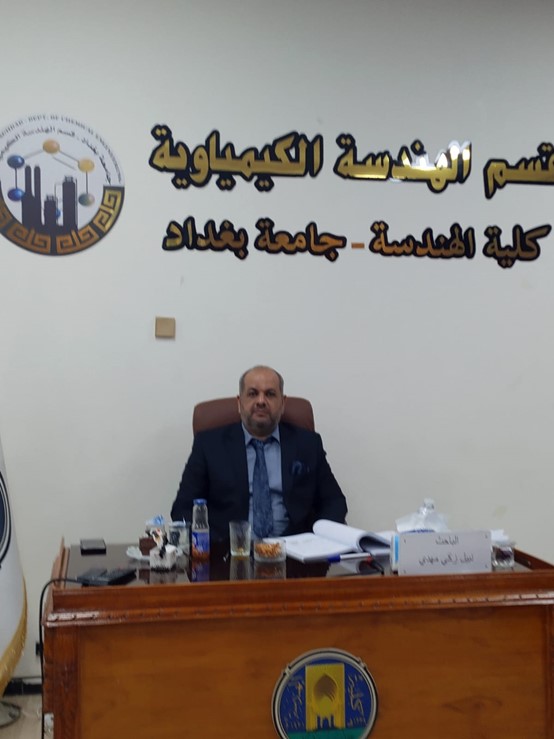
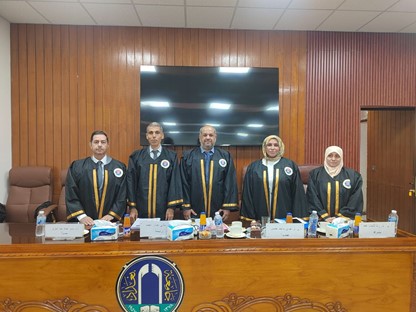
The Chemical Engineering Department at the College of Engineering, University of Baghdad, held a M.Sc. thesis examination titled:
“ Synthesis and Adsorption Performance of Activated Carbon/HKUST-1 Composites for Methylene Blue Removal from Aqueous Solutions“
By the student “Nabeel Zaki Mahdi” and supervised by Assist. Prof. Dr. Rana Thabet Abd. The examination committee consisted of Prof. Dr. Muthanna Jabbar Ahmed as Chairman and the membership of Assist.Prof. Dr. Dr.Yasser Emad Abd-el Aziz and Lecturer Dr. Huda Majid Hasan. The thesis was accepted after conducting a public discussion and listening to the student’s defense. The thesis was summarized as follows:
The aim of study:
synthesize and evaluate of AC/HKUST-1 composite adsorbent for dye removal by integration activated carbon into HKUST-1 framework, this study aims to enhance its structure properties.
Abstract:
In this study, a hybrid porous composite of activated carbon and HKUST-1 (Cu3(BTC)2 a type of metal-organic framework.) was fabricated and characterized to enhance the structural framework of a candidate modified adsorbent. This work reports a one pot solvothermal synthesis of an activated carbon / HKUST-1 porous composite to provide structural stability and adsorption efficiency in aqueous environments. activated carbon has been integrated into its preparation to improve the adsorption and the structural stability of HKUST-1 results from XRD, SEM, FTIR, BET and EDX revealed an efficient preparation method to create a hybrid structure where well-dispersed HKUST-1 crystals were attached on the activated carbon surface providing a porous structural.
The conditions studied: Percentage of activated carbon in the (0,5,10,15 wt %) Solution pH (2-12), contact time (0.5 to 3.5 hours), adsorbent dose at (0.5to3.5g/L), initial concentration (20,50,100 ,150, 200,250,and 300 ppm) , agitation speed of an agitation speed=200 rpm, and temperature at 25°C. The highest removal percentage of methylene blue was 97% accompanied by a maximum adsorption capacity qmax of 282.5 mg/g . the optimal results were found at pH 7.5,a contact time of 2 hours, an adsorbent dosage of 2 g /L and an activaited carbon of 10 wt %.
The hybrid composite was evaluated in terms of adsorption performance using methylene blue as a model organic contaminant. The 10 wt% activated carbon/HKUST-1 composite showed the highest removal rate of 97% which is higher than removal rate of pure HKUST-1 85% while that of pure activated carbon was 66.53%.Furthermore AC/ HKUST-1 was found to be reusable, with its removal efficiency only dropping by only about 7.67 % after four cycles of use compared to its initial. efficiency.
By hydrothermal synthesis method is a chemical process used ethanol at high temperatures. A solution was prepared by dissolving copper (II) nitrate tri-hydrate (Cu(NO3)23H2O),trimesic acid (H3BTC),activated carbon in ethanol, the resulting mixture was mixed at 200 (rpm) at a temperature of 25 ℃ for 17 minutes ,the suspension was introduced into a Teflon autoclave vessel at 120o C for 24 h . The powder that resulted from the reaction was filtered and then washed twice with a 60 ml ethanol. It is then dried in a dryer for 5 hours at 60 °C.
The surface area of the10 wt % of AC loaded was determined to be 541.032 m2/g, with the pore volume was measured to be 0.3039 cm3/g, which suggested that this sample would be a qualified adsorbent.
Under specific conditions 10 wt % of AC loaded , solution acidity of pH 7.5 , contact time of 2 hours, several MB concentration (20,50,100,150,200,250,and 300 ppm) and isothermal condition justified at 25 °C, isothermal condition (Langmuir, Freundlich and Temkin models) were investigated to evaluate the use of AC/HKUST-1 as an adsorbent for removal of methylene blue (MB) from an aqueous solution in isothermal adsorption process.
The results of the adsorption of methylene blue under isothermal conditions best fit to the Freundlich model, as reflected by a high correlation coefficient (R2) on 0.99.The adsorption kinetics were better described by the pseudo-second model.
This hybrid composite structure shows excellent promise for wastewater treatment and broader environmental remediation .