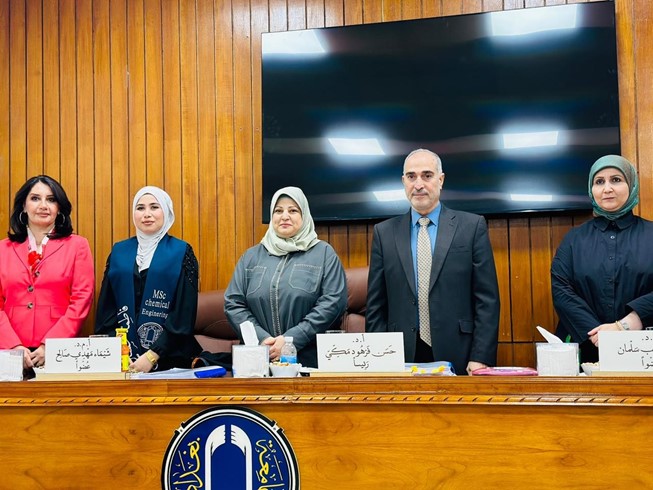
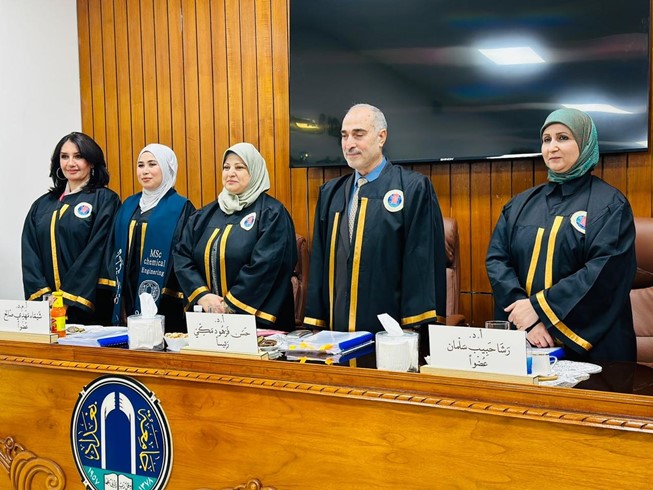
The College of Engineering at the University of Baghdad witnessed the public defense of the master’s thesis by Fatima Hussein Mohammed Ali in the Department of Chemical Engineering. Her thesis, titled “Electrodes Performance Analysis via Electrocoagulation Process of Simulated Wastewater,” was presented on Tuesday, 8 September 2026, in Professor Mahmoud Omar Hall within the Department of Chemical Engineering, under the supervision of Asst. Prof. Dr. Shaymaa A. Ahmed and Asst. Prof. Dr. Forat Yasir AlJaberi.
The study addressed the treatment of dye-containing wastewater using electrocoagulation (EC), with particular emphasis on how the corrosion-passivation behavior of the sacrificial anode influences process efficiency. A 1:1 mixture of the anionic dye Congo Red (CR) and the cationic dye Methylene Blue (MB) was used to develop an electrode-selection strategy based on the electrochemical behavior of the anode rather than comparative testing alone.
The work was conducted in three stages. First, the corrosion behavior of aluminum (Al), iron (Fe), and stainless steel (SS) was investigated using open-circuit potential (OCP), cyclic polarization, Tafel analysis, and FESEM characterization. Aluminum emerged as the best anode because it maintained the release of Al³⁺ ions required for coagulant generation while avoiding complete surface passivation.
Second, with aluminum fixed as the anode, the Al/Al, Al/Fe, and Al/SS electrode combinations were compared for chemical oxygen demand (COD) removal using a 300 ppm dye mixture, equivalent to 2190 mg/L COD, at an applied current of 1 A, an initial pH of 6, and a stirring rate of 150 rpm. The Al/Fe pair achieved the highest COD reduction of 93.47% after 90 min, compared with 83.26% for Al/Al after 60 min and 79.15% for Al/SS after 75 min. Al/Fe was also the most energy-efficient electrode pair.
In the third stage, the Al/Fe pair was used to investigate the effects of operating variables. The studied ranges were pH 2–10, current 0.6–1.4 A, dye-mixture concentration 100–500 ppm, and electrolysis time 4–90 min. Response surface methodology based on a central composite design (RSM-CCD), together with analysis of variance (ANOVA), was used to model COD reduction, electrode consumption, energy consumption, and OCP behavior.
Optimization showed that operating conditions of 0.6 A, pH 7.98, 4 min electrolysis time, and an initial dye concentration of 500 ppm, corresponding to 4236.7 mg/L COD, produced a predicted COD reduction of 94.57%, with an actual value of approximately 88.9%, while minimizing energy and anode consumption. The findings also demonstrated that dye type and mixture composition strongly influence EC performance through their effect on anode corrosion behavior.
The examining committee recommended applying the polarization-based pre-selection approach to additional metals, alloys, and composite electrodes, such as titanium and zinc, to determine whether the selection criterion can be generalized beyond the three metals examined in the study. The committee also recommended recording the open-circuit potential across every level of the operating variables to provide a more complete representation of the interaction between anode condition and process conditions.
The committee further recommended validating the selected configuration using genuine industrial textile wastewater containing competing ions, surfactants, and buffering agents; expanding the response-surface design to multi-dye mixtures and different dye ratios rather than the fixed 1:1 ratio used in the present study; and testing the feasibility of a continuous-flow reactor instead of the batch cell, together with characterization of the sludge produced at that scale.