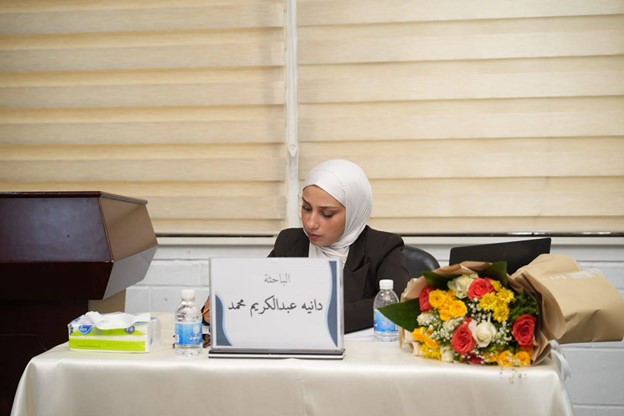
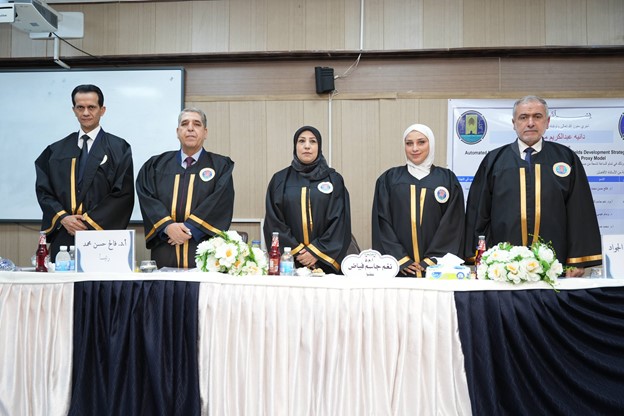
The College of Engineering at the University of Baghdad, Department of Petroleum Engineering, held a public discussion of the MSc thesis submitted by researcher Dania Abdulkarim Mohammed, entitled “Automated Machine Learning Approaches for Developing a Development Plan for Undeveloped Oil Fields Using Optimal Techniques Coupled with a Proxy Model.” The discussion took place on Tuesday, September 8, 2026, in the Postgraduate Studies Hall at the Department of Petroleum Engineering, under the supervision of Prof. Dr. Mohammed Saleh Al-Jawad.
The examination committee consisted of the following members:
- Prof. Dr. Falih Hassan Mohammed – Chair
- Assoc. Prof. Dr. Nagham Jassim Fayyad – Member
- Dr. Wissam Issa Taher – Member
- Prof. Dr. Mohammed Saleh Al-Jawad – Member and Supervisor
The thesis aimed to develop an automated approach based on a proxy model and optimization techniques to identify a suitable development strategy for an undeveloped oil field by optimizing well locations and production rates. The proposed approach can also be applied to other undeveloped oil fields by adapting the input data and the operational and reservoir constraints specific to each field.
The methodology was applied to the Zubair Formation in the Dhufriya Oil Field. The study included well-log interpretation and the construction of geological and dynamic reservoir models. The results indicated that the Middle Zubair unit represents the principal reservoir unit, with an estimated original oil in place of approximately 22 million standard cubic meters (Sm³).
The researcher also developed an automated, physics-informed method using Python to generate the simulation cases required to establish a database representative of reservoir behavior. This approach reduced manual work and enabled the efficient generation of the required simulation cases with less effort.
Subsequently, two proxy models were developed using XGBoost and Long Short-Term Memory (LSTM) techniques. The LSTM model demonstrated higher predictive accuracy, achieving a coefficient of determination (R²) of approximately 0.9956 on the test dataset. Accordingly, it was selected and integrated with a Genetic Algorithm (GA) using a multi-objective function designed to maximize cumulative oil production, extend the period of stable production rates, and minimize water cut.
Following a comparison of six production scenarios, the results demonstrated that changing the weights assigned to the objective function significantly affected optimal well locations, production rates, and reservoir responses. The second scenario was identified as the most suitable development strategy, achieving a field production rate of 468 Sm³/day, maintaining production-rate stability for approximately 900 days, and yielding cumulative oil production of around 830,500 Sm³ over five years.
The study presented several recommendations, most notably reassessing the field’s hydrocarbon potential when new data become available and conducting history matching to reduce uncertainty. It also recommended investigating the use of horizontal wells and alternative well-distribution patterns, as well as extending the study to include other production and recovery strategies, such as water injection.
Following the scientific discussion, during which the examination committee evaluated the thesis and listened to the researcher’s defense, the committee awarded the researcher a Master’s degree in Petroleum Engineering.