
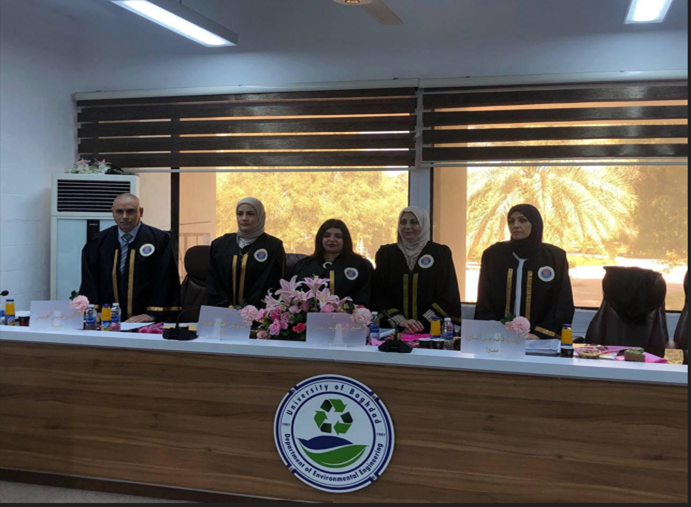
Environmental Engineering Department at the College of Engineering, University of Baghdad, held MSc dissertation examination titled:
“Green synthesis of Zinc oxide nanoparticles using leaves extract and
its application in Tetracycline removal from aqueous solution: batch
and continuous studies “
By the student Zahraa Alaa-Aldeen Abdulmajeed and supervised Prof. Dr. Ahmed Abd Muhammed on Monday 16/2/2026, in the Environmental Engineering discussion hall. The examination committee consisted of Prof. Dr. Abeer Ibraheem Musa as Chairman, and the membership of Assist. Prof. Dr. Sabreen Lateef Kareem and Lect. Dr. Zainab Kadhim Abdulsada. After conducting the public discussion and listening to the student’s defense, the dissertation was accepted. It was summarized as follows:
Extracts derived from plant-based and agricultural bio-wastes have been widely utilized for the sustainable,cost effective, and environmentally friendly synthesis of various metal nanoparticle. The present study has proposed synthesizing zinc oxide particles (ZnO) by a green chemistry route using waste tea leaves extract to sequestrate tetracycline antibiotic (TEC) from wastewater. The prepared ZnO NPs were characterized using TEM, SEM, XRD, FTIR, BET, and through the determination of pHpzc. The surface of the ZnO exhibits a highly heterogeneous texture with irregular, aggregated particles and rough surfaces with a BET surface area of 41.7 m²/g. Batch adsorption experiments were conducted, as well as the influence of solution pH, initial concentration, contact duration, adsorbent dose, temperature, and shaking speed were studied. The results showed that the prepared ZnO NPs could effectively adsorb > 95% of TEC from wastewater under the optimal conditions (pH 5.5, agitation speed 200 rpm, dosage of the adsorbent 0.4 g/100 ml, temperature 298 K, and 100 ppm initial TEC concentration at 120 min contact time). The kinetics of the adsorption describes well by Pseudo-second order model with a KR2R value of 0.004 g/mg-min for a TEC concentration of 100 mg/l, while the mechanism was
controlled by external mass transfer and intra-particle diffusion. The Langmuir isotherm effectively represents adsorption at equilibrium , highlighting the maximum adsorption capacity of 110.56 mg/g, and this provides evidence of a monolayer adsorption phenomenon. Negative Δ°H and Δ°G were indicative of an exothermic and spontaneous nature. The synthesized ZnO NPs also exhibited good regeneration potential, with only a 31% reduction in efficiency was observed after five regeneration-adsorption cycles.
In the final stage, adsorption experiments were performed in a fixed-bed column to investigate the impact of varying flow rates (5, 10, 15 mL min⁻¹), bed heights (5, 10, 15 cm), and inlet concentrations (15, 25, 50 mg L⁻¹) on the adsorption process. The experimental breakthrough curves were analyzed using four widely recognized fixed-bed approaches. Of these, the models corresponding to Bohart–Adams and Yoon–Nelson provided the closest fit to the observed data. Overall, the findings suggest that ZnO nanoparticles are highly effective and promising adsorbents for removing antibiotics from wastewater.
The Recommendations of this dissertation.
1.It is also important to consider other plant extracts high in phytochemicals. We will then be able to compare which of them is most effective in making nanoparticles.
2.There are also mechanism studies that are of equal interest. In these studies, the latest spectroscopy techniques are used to elucidate the mechanism of ZnO interaction with tetracycline.
3.Pilot-scale trials: Scale up the synthesis procedure from the laboratory setup to a larger scale using actual wastewater.
4.Integrating both adsorption and photocatalytic degradation: Combining both adsorption and photocatalytic degradation to enhance both tetracycline removal capacity as well as pollutant degradation.