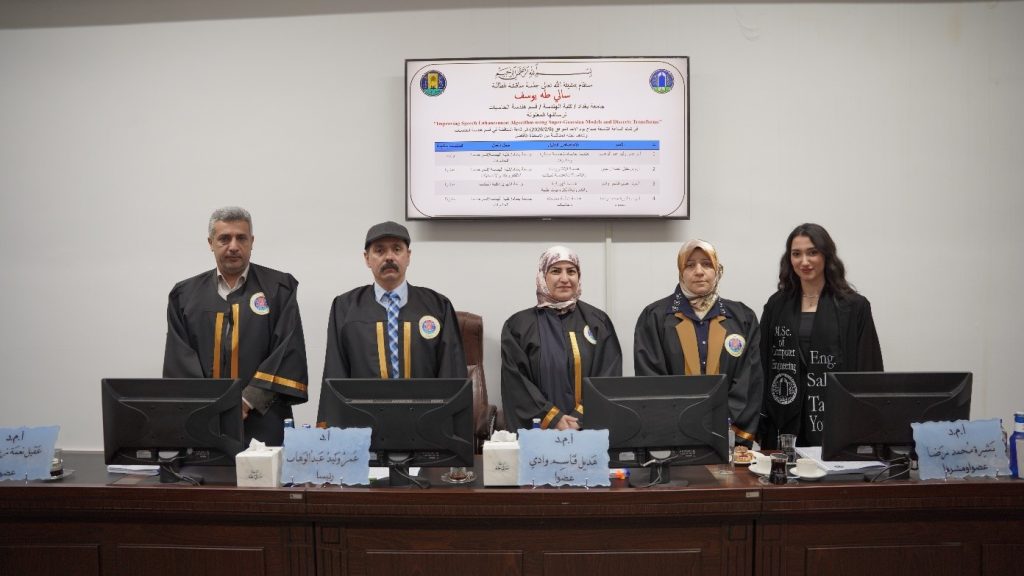
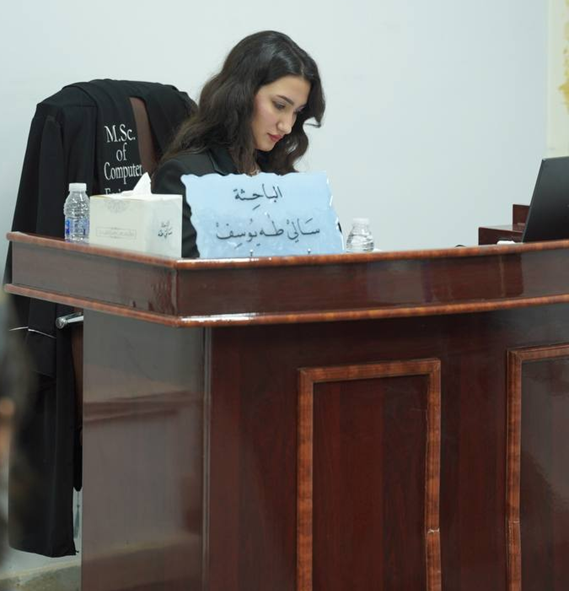
The College of Engineering, University of Baghdad, witnessed the public discussion of the master’s student (sally Taha Yousif) from the Department of Computer Engineering. Her thesis was entitled ” Improving Speech Enhancement Algorithm using Super-Gaussian Models and Discrete Transforms.”
On Sunday, February 8, 2026, in the discussion hall of the Department of Computer Engineering, under the supervision of Asst. Prof. Dr. Basheera Mohammed Redha Mahmood.
The discussion committee consisted of the following members:
- Chair:
Prof. Dr. Omar Walid Abdulwahab — University of Baghdad / College of Engineering / Department of Computer Engineering — Specialization: Control Engineering and Computer Engineering. - Member:
Asst. Prof. Dr. Aqeel Naama Zaian — University of Baghdad / College of Engineering / Department of Electronics and Communications Engineering — Specialization: Communication Engineering / Network Engineering. - Member:
Asst. Prof. Dr. Hadeel Qasim Wadi — Al-Nahrain University / College of Engineering — Specialization: Electrical and Electronic Engineering / Biomedical Electronics. - Supervisor:
Asst. Prof. Dr. Basheera Mohammed Redha Mahmood — University of Baghdad / College of Engineering / Department of Computer Engineering — Specialization: Embedded Systems Engineering and Computer Engineering.
This thesis aimed to develop an advanced speech enhancement system capable of improving noisy speech quality and intelligibility under different acoustic environments. The proposed work combined classical digital signal processing with perceptually motivated modeling to achieve a robust enhancement framework that balances noise suppression and speech preservation.
The thesis also included a comprehensive study covering the preparation of noisy speech signals based on the TIMIT corpus, multi-noise evaluation scenarios (White, Pink, Car, Airport, and F16), and the implementation of a novel hybrid estimator called Dual-Stage Harmonic and Perceptual Speech Enhancer (DSHP-SE). The proposed estimator integrates the Dual-Masking Harmonic-based method (DMH) as a first stage for suppressing broadband and harmonic-correlated noise (via TSNR and HRNR modules), followed by the Perceptually-motivated Karhunen–Loève Transform (PKLT) as a second stage for perceptually guided subspace refinement using psychoacoustic masking concepts. In addition, a multi-objective optimization strategy based on the Weighted Sum Method (WSM) was employed to automatically tune the key parameters of both DMH and PKLT, using objective performance measures including PESQ, STOI, SNRseg, Csig, Cbak, and Covl. The results demonstrated that the proposed system provides consistent improvements and achieves a better trade-off between noise reduction and speech distortion, particularly under low-SNR conditions, confirming its potential applicability in practical speech communication systems.
The thesis concluded with a set of recommendations, including:
- Expanding the evaluation to larger and more diverse datasets and noise conditions to further ensure the generalization capability of the proposed system.
- Integrating deep learning models within the hybrid framework to enhance adaptability under unseen noise environments while maintaining efficiency.
- Conducting subjective listening tests alongside objective metrics to validate perceptual quality more accurately.
- Investigating real-time implementation and deployment for practical applications such as hearing aids, telecommunications, and automatic speech recognition systems.
- Adding an automatic noise-type detection module to enable dynamic selection/adaptation of optimized parameters in real-world scenarios.
After a scientific discussion by the members of the discussion committee, listening to the researcher’s defense, and evaluating the thesis, the researcher was awarded a master’s degree in computer engineering.