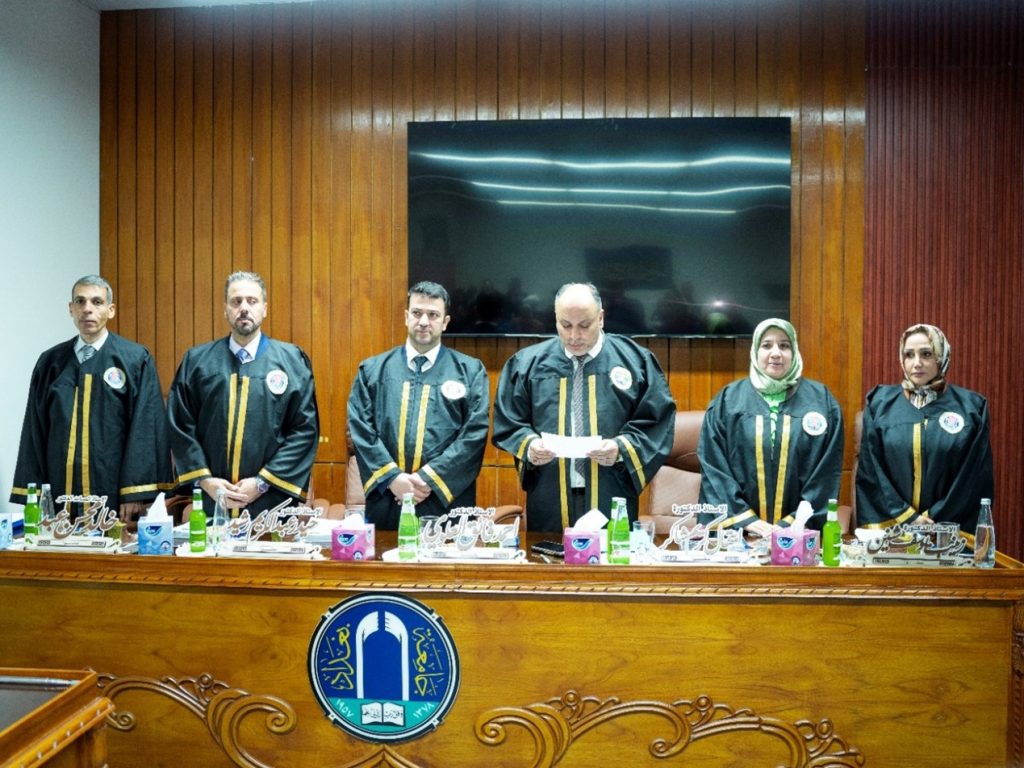
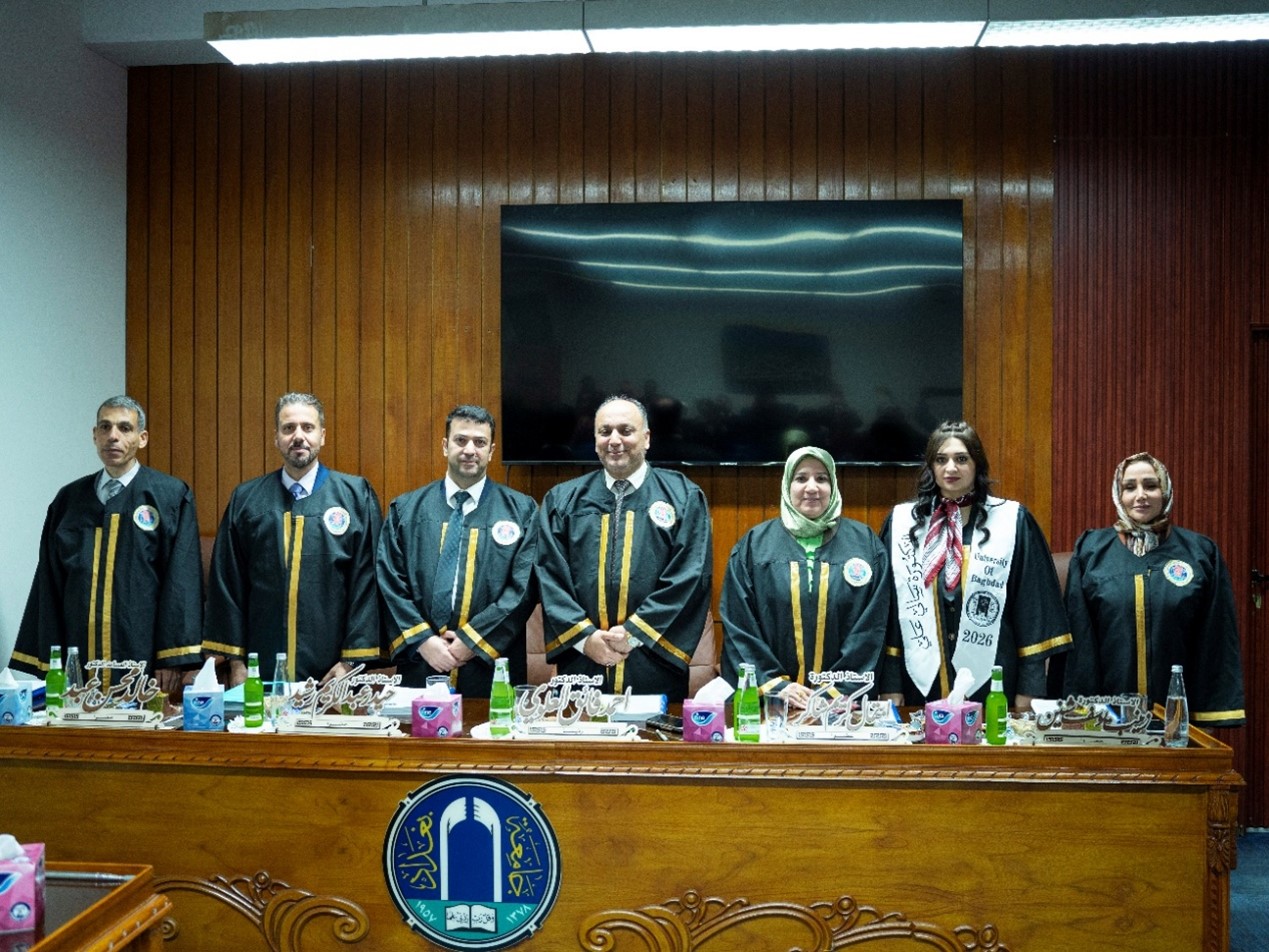
The Chemical Engineering Department at the College of Engineering, University of Baghdad, held a PhD dissertation examination titled:
Sustainable Removal of Nitrate and Phosphate Using Char Derived from Co-Pyrolysis of Waste Tires and Biomass
By the student “Sally Ali Hussein” and supervised by Prof. Dr. Muthanna Jabar Ahmed. The examination committee consisted of Prof. Dr. Ahmed Faiq Al-alawy as Chairman and the membership of Prof. Dr. Ibtehal K. Shaker, Prof. Dr. Hayder Abdulkareem Rasheid, Prof. Dr. Zainab Yousif Shnain, and Ass. Prof. Dr. Khalid M. Abed. The thesis was accepted after conducting a public discussion and listening to the student’s defense. The thesis was summarized as follows:
The aim of study:
This study aims to prepare and evaluate an adsorbent biochar produced via co-pyrolysis of waste tires and biomass (date stones and corn cobs) for the removal of nitrate and phosphate ions from aqueous systems. Char materials will be synthesized under different blending ratios, temperatures, and residence times, then systematically characterized. Their adsorption performance will be assessed through controlled batch experiments, including equilibrium and kinetic studies in single- and binary-component systems to examine competitive interactions and surface mechanisms. The study also investigates dynamic adsorption in fixed-bed columns by analyzing the effects of influent concentration, flow rate, and bed height on breakthrough behavior, alongside the development and validation of mathematical models to describe mass transfer and adsorption processes.
Abstract:
Excessive concentrations of inorganic nutrients, particularly nitrate (NO₃⁻1) and phosphate (PO₄—³), represent a critical environmental challenge due to their direct role in the eutrophication of aquatic systems. These pollutants primarily originate from agricultural runoff, wastewater discharge, and industrial effluents, leading to accelerated algal blooms, depletion of dissolved oxygen, ecological imbalance, and deterioration of water quality. The persistent presence of these nutrients in water bodies necessitates the development of efficient, sustainable, and economically viable treatment technologies capable of mitigating their environmental impact.
This study investigates the valorization of solid waste materials through co-pyrolysis as an innovative approach for producing high-performance adsorbents. Waste tires (WT), as a carbon-rich industrial waste, were co-pyrolyzed with two types of biomass date stones (DS) and corn cobs (CC) to synthesize functional char materials for nitrate and phosphate removal from aqueous solutions. The influence of key operational parameters, including blend composition (100% WT, 75%WT+25%biomass, 50%WT+50%biomass, 25%WT+75%biomass, and 100% biomass), pyrolysis temperature at 400, 500, 600, 700, 800, and 900 °C, and residence time at 60, 90, 120, 150, and180 min, was systematically evaluated to optimize char yield and adsorption performance. The findings revealed a pronounced synergistic effect at a blend ratio of 25% WT + 75% biomass for both DS and CC, producing char with enhanced surface functionality and superior adsorption capacity.
Comprehensive physicochemical characterization was conducted using FE-SEM, EDS, FTIR, zeta potential measurements, and BET surface area analysis. The results confirmed that co-pyrolysis significantly improved pore development, surface area, and the abundance of oxygen-containing functional groups, thereby enhancing the interaction between the adsorbent surface and nutrient species. These structural and chemical modifications played a crucial role in improving adsorption efficiency.
Batch adsorption experiments were performed to evaluate equilibrium and kinetic behavior under both single-component and competitive systems. The equilibrium data for individual nitrate and phosphate adsorption were best described by the Sips isotherm model, demonstrating excellent correlation coefficients (R² values exceeding 0.99). The maximum adsorption capacities reached 40.00 and 73.23 mg/g for nitrate and phosphate, respectively, using char derived from date stones, while higher capacities of 37.44 and 62.15 mg/g were obtained for char derived from corn cobs. In competitive systems, the modified extended Langmuir model provided the most accurate representation of adsorption behavior.
Kinetic analysis indicated that the pseudo-second-order model best described the adsorption process, suggesting that chemisorption mechanisms predominantly govern nutrient uptake.
To evaluate practical applicability, dynamic adsorption experiments were conducted using a fixed-bed column system. Breakthrough curves were analyzed under varying inlet concentrations, flow rates, and bed heights to assess operational performance. Furthermore, numerical simulations based on a mathematical equilibrium model and a Linear Driving Force (LDF) model were employed to predict column behavior. The equilibrium model exhibited superior predictive capability, with correlation coefficients exceeding 0.997 for both nitrate and phosphate adsorption on both types of char. Although the LDF model provided reasonable predictions, its correlation coefficients were comparatively lower. Mass transfer coefficients were higher for char derived from corn cobs than for char derived from date stones, indicating enhanced transport properties.
Overall, this research demonstrates that co-pyrolysis of waste tires with agricultural biomass is an effective strategy for producing high-efficiency adsorbents for nutrient removal. The optimized char materials exhibited excellent adsorption capacity, favorable kinetic behavior, and strong predictive performance under dynamic conditions.