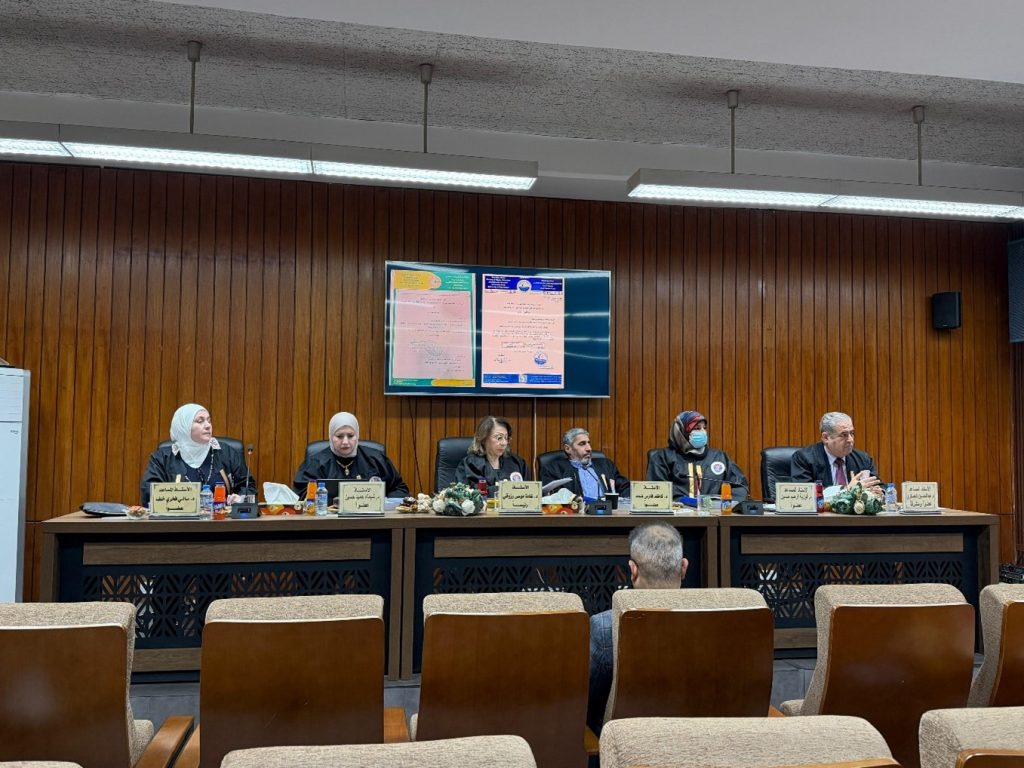
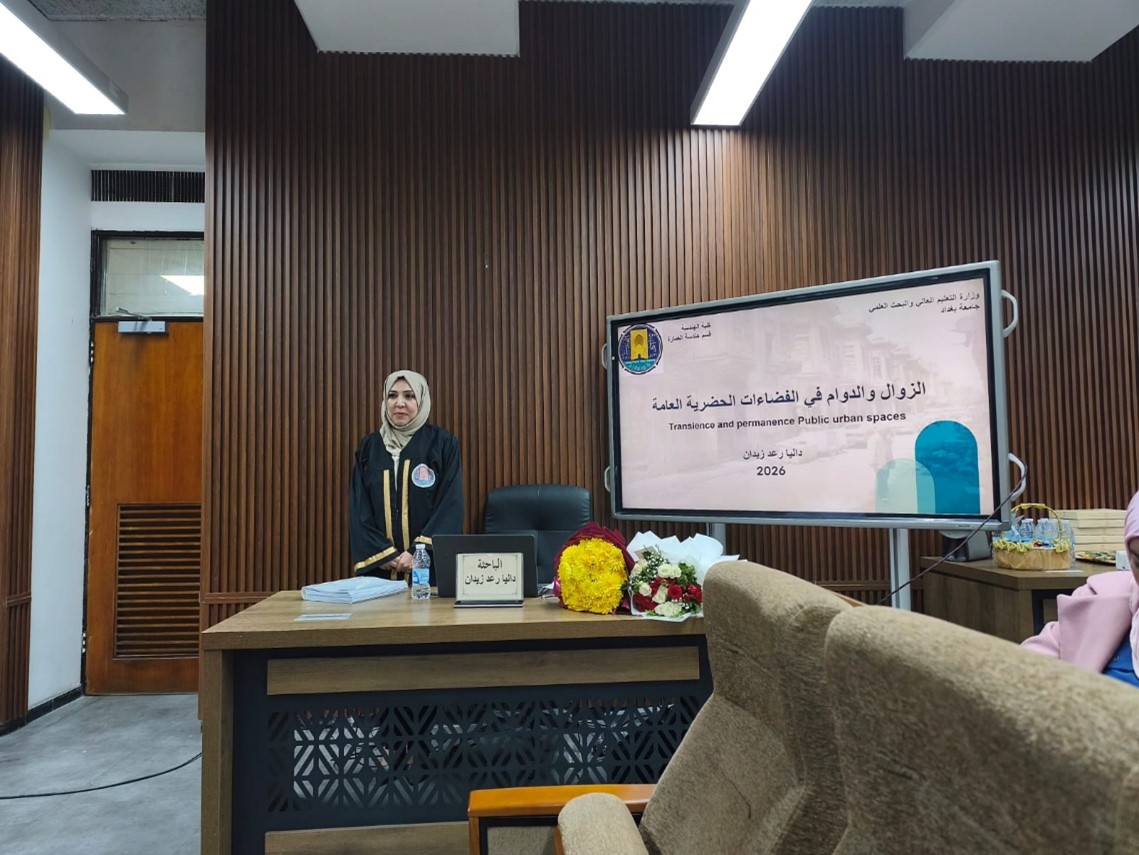
The College of Engineering at the University of Baghdad witnessed, on Monday, January 26, 2026, the public defense of the PhD dissertation submitted by Ms. Dalia Raad Zaidan, from the Department of Architectural Engineering, entitled:
“Ephemerality and Permanence in Public Urban Spaces”
The defense was held at Mohammad Makiya Hall at 9:00 a.m., under the supervision of Assistant Professor Dr. Abdulhussein Al-Askari.
The primary objective of this research was to establish a comprehensive theoretical framework for the model of ephemerality and permanence in public urban spaces at both the design and planning levels. This was achieved by highlighting the mechanisms that sustain permanence in public urban spaces through a composite strategy consisting of two approaches. The first is the PEA approach, with its mechanisms of Protect, Enhance, and Add, while the second is the Lateral Urbanization Pyramid approach, based on the intersection of Maslow’s Hierarchy of Needs and the Sustainability Pyramid, and relying on SWAR analysis (Strengths, Opportunities, Aspirations, and Results) instead of the traditional SWOT analysis, which focuses on weaknesses and threats. These mechanisms guide urban spaces toward transformation from resilience to sustainability, ultimately leading to prosperity.
The research addressed two main urban scenarios. The first scenario involves the transition from ephemerality to permanence according to specific strategies. The second scenario represents the transition from permanence to ephemerality as a result of continuous pressure on spatial infrastructure due to erosion, fragmentation, changes in land use, and increased population density. Consequently, the space may reach a stage where it is no longer capable of meeting users’ needs, leading to a state of partial permanence. In this context, the proposed model functions as a dynamic compass, oscillating between ephemerality and permanence when applied to urban spaces.
Through the application of the hypothetical model to case studies in the city of Baghdad, the research concluded that ephemerality may be physical or material, resulting from the continuous erosion of spatial areas and infrastructure. Non-material ephemerality, however, may result from the loss of spatial quality, including social and functional decline, as well as the erosion of the sense of place.
One of the key findings of the study is that the causes of ephemerality and permanence in public urban spaces stem from several driving forces, most notably excessive development, privatization, globalization, securitization, technology, mobility, and intellectual transformations, particularly the emergence of postmodern paradigms such as “liquid modernity” proposed by Zygmunt Bauman, and the invasive digital paradigm introduced by Stéphane Vial.
The research also identified four stages of ephemerality: erosion, contraction, weakness, and urban blight. Moreover, it concluded that permanence in public urban spaces is not an absolute or final state, but rather a temporary condition that requires conscious and continuous management to sustain it.
The examination committee consisted of:
- Prof. Dr. Ghada Mousa Rzouqi – Chairperson
- Prof. Dr. Shaimaa Hamid Hussein – Member
- Prof. Dr. Kazem Fares Dhamad – Member
- Asst. Prof. Dr. Fawzia Arhaim Hussein – Member
- Asst. Prof. Dr. Sally Fakhri Khalaf – Member
- Asst. Prof. Dr. Abdulhussein Al-Askari – Supervisor
Following the scientific discussion, evaluation of the dissertation, and the candidate’s defense, the committee decided to award Ms. Dalia Raad Zaidan the degree of Doctor of Philosophy (PhD) in Architectural Engineering.