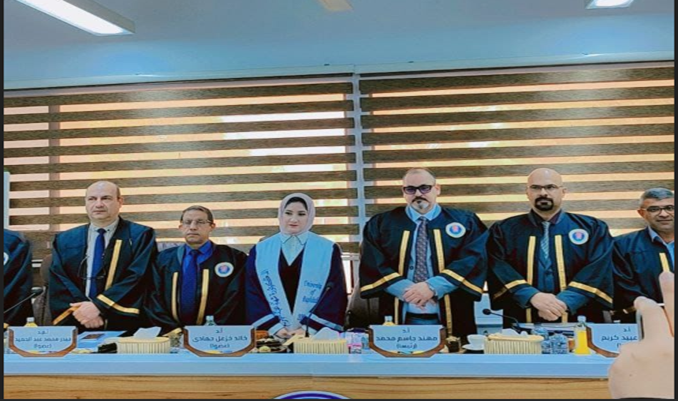
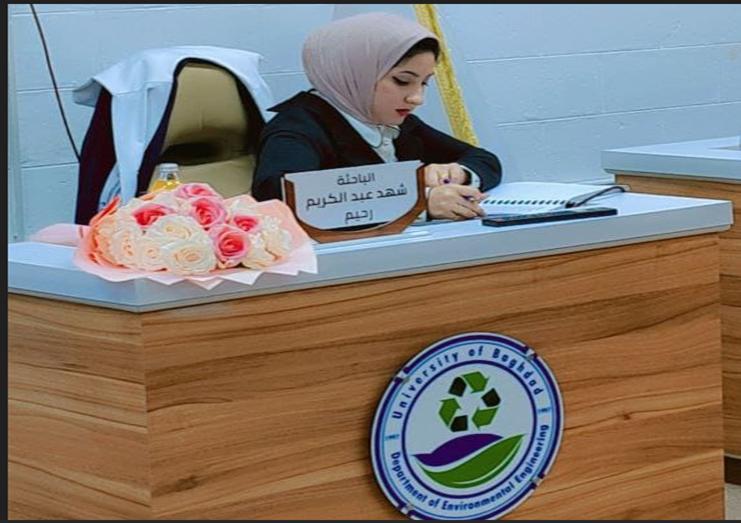
Environmental Engineering Department at the College of Engineering, University of Baghdad, held Phd dissertation examination titled:
“Preparation, characterization, and Adsorptive Performance of NiAlFe-LDH Polystyrene Nanocomposites in Lead and Cadmium Ions Removal from Aqueous Solutions “
By the student Shahad Abdul Kareem Raheem and supervised Prof. Dr. Ahmed Abd Muhammed on Wednesday 11/2/2026, in the Environmental Engineering discussion hall. The examination committee consisted of Prof. Dr. Muhanad Jassem Mohammed as Chairman, and the membership of Prof. Dr. Khalid Khazaal Humady, Prof. Dr.Nagham Obaid Kareem, Assist.Prof.Dr.Hayder Muhammed Abdul Hameed and Assist.Prof.Dr.Nabeel Majed Alaiwi After conducting the public discussion and listening to the student’s defense, the dissertation was accepted. It was summarized as follows:
Toxic heavy metals have adverse effects on the health of all living organisms, and their presence in aquatic environments is a significant concern. In this study, a core-shell nanocomposites (NiAlFe-LDH@PS and PS@NiAlFe-LDH) was synthesized by recycling Expanded Polystyrene (EPS) waste. NiAlFe-LDH@PS was prepared with a PS:LDH ratio of 2:1, and NiAlFe-LDH@PS was prepared with a LDH:PS ratio of 3:1. Both nanocomposites were characterized using TEM, SEM/EDS, XRD, FTIR, and BET to determine their structural morphology, elemental composition, surface area, and pore morphology. The adsorptive ability of NiAlFe-LDH@PS and PS@NiAlFe-LDH nanocomposites toward Pb+2 and Cd+2 ions in single and binary systems was evaluated. NiAlFe-LDH@PS characterization results showed a hexagonal platelet morphology of NiAlFe-LDH uniformly covered by a shell of PS nanosphers and a successful adsorption of Cd+2 and Pb+2 ions on NiAlFe-LDH@PS. Characterization of PS@NiAlFe-LDH indicated the successful formation of PS nanosphers core coated by platelet LDH shell. The optimization and influence of adsorption parameters (pH, dosage, agitation speed, initial concentration, and contact time) on the adsorption process were investigated using RSM analysis, yielding a good fit between experimental data and predicted responses with a correlation coefficient (R2) of 0.9956 and 0.9521 for Cd+2 and Pb+2, respectively, for NiAlFe-LDH@PS nanocomposite, 0.9892 and 0.948, respectively, for PS@NiAlFe-LDH nanocomposite. Adsorption experiments showed that the removal efficiency of Cd+2 and Pb+2 in a single-component system was 94.42% and 99.65%, respectively, for NiAlFe-LDH@PS, and 95.53% and 97.96%, respectively, for PS@NiAlFe-LDH. While in the binary system, the removal efficiencies of Cd+2 and Pb+2 were reduced, indicating that Cd+2 and Pb+2 adsorption was affected by the presence each other. Langmuir isotherm model with a maximum capacity of 177.305 mg/g (lead) and 57.4713 mg/g (cadmium) on NiAlFe-LDH@PS, and 111.11 mg/g (lead) and 227.273 mg/g (cadmium) on PS@NiAlFe-LDH, and the competitive Langmuir model best described the adsorption data in a single-and binary-component system. In a single-component system, PSO models accurately described the adsorption on both nanocomposites, indicating that the rate-controlling step for Pb+2 and Cd+2 adsorption was a chemical reaction, indicating a chemisorption process. Additionally, the modified PSO was used to describe the binary adsorption data for NiAlFe-LDH@PS and PS@NiAlFe-LDH nanocomposites. Electrostatic force interaction, interactions with oxygen-containing functional groups, and complexation reactions controlled the adsorption process. NiAlFe-LDH@PS and PS@NiAlFe-LDH nanocomposites showed significant reusability as the efficiency for Cd+2 and Pb+2 was 38.56% and 42.37%, respectively, for NiAlFe-LDH@PS, 57.5% and 40.54%, respectively, for PS@NiAlFe-LDH, after six regeneration cycles. ANOVA analysis, 2D contour, and 3D surface plots for both nanocomposite showed significant interactions between parameters. Fixed-bed column tests showed that reducing the flow rate improved the column’s adsorption performance. Increasing the initial concentration resulted in a higher breakthrough points, causing adsorption sites to saturate more quickly. Increasing the column height improved adsorption performance as the amount of the nanocomposites increased. The Bohart–Adams, Thomas, Yoon–Nelson, and Clark models showed good fitting with experimental data, with correlation coefficients R² > 0.93 and SSE ≤ 0.2. The Thomas model best matched the experimental data. In conclusion, NiAlFe-LDH@PS and PS@NiAlFe-LDH nanocomposites can be considered as an effective adsorbent in the treatment of aqueous solutions contaminated with heavy metals.
The Recommendations of this dissertation.
- An investigation into the feasibility of preparing NiAlFe-LDH using green chemistry can be conducted to reduce the cost of producing the adsorbents.
- Further investigations are recommended to assess the potential of NiAlFe-LDH@PS and PS@NiAlFe-LDH nanocomposites for the removal of a wider range of contaminants, including pharmaceutical residues, pesticides, persistent organic pollutants, and explosive compounds.
- The performance of NiAlFe-LDH@PS and PS@NiAlFe-LDH nanocomposites can be evaluated in the treatment of real water containing organic and inorganic impurities, to assess their resistance to complex interferences compared to laboratory-prepared solutions.
- Investigating the influence of temperature on the adsorption capacity and model parameters could help clarify the adsorption mechanism and the thermodynamic behaviour of the system.
- Advanced mathematical models or computational fluid dynamics (CFD) simulations could be employed for a better understanding of the mass-transfer limitations and concentration profiles within the column.
- Evaluate NiAlFe-LDH@PS PS@NiAlFe-LDH nanocomposites in multi-stage column systems or columns with different diameters to simulate industrial-scale operating conditions.