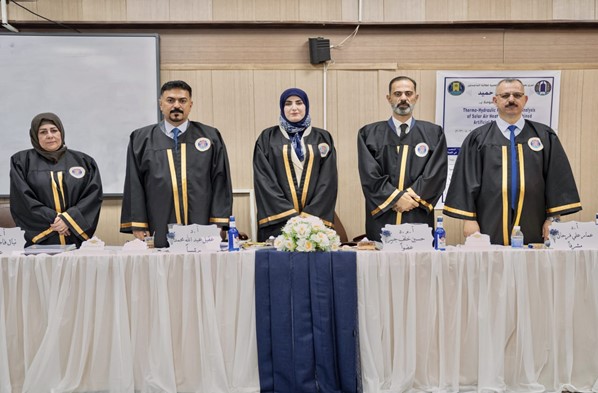

The College of Engineering at the University of Baghdad held the public defense of the Master’s thesis submitted by Taqa Hussein Hamid from the Department of Energy Engineering, entitled:
“Thermo-Hydraulic Performance Analysis of Solar Air Heaters with Compound Artificial Roughness Using CFD.”
The defense was held on Sunday, August 30, 2026, in the Petroleum Engineering Hall, under the supervision of Prof. Dr. Ammar Ali Farhan.
Thesis Objectives
The thesis aimed to investigate the thermal and hydraulic performance of a double-pass solar air heater with parallel flow, incorporating transverse circular ribs installed on both sides of the central absorber plate.
The study examined the effects of rib height, rib pitch, and Reynolds number on heat transfer, pressure drop, and overall thermo-hydraulic performance, with the objective of identifying the optimum design and operating conditions for the solar air heater.
The thesis also included a numerical investigation using ANSYS Fluent to analyze airflow and heat transfer within the upper and lower channels, as well as to evaluate the effects of various geometric and operating parameters on the performance of the double-pass solar air heater.
Key Recommendations
Based on the findings of the study, the thesis proposed several recommendations, including:
- Conducting future numerical and experimental investigations of double-pass solar air heaters using different rib configurations, such as triangular or inclined ribs, and comparing their thermal performance with that of circular ribs.
- Investigating the use of perforated circular ribs in double-pass solar air heaters in future studies to evaluate their effects on heat transfer, pressure drop, and thermo-hydraulic performance.
- Conducting experimental investigations to validate the numerical results obtained in this study and enhance the reliability of the numerical model used to analyze the thermal and hydraulic performance of the double-pass solar air heater.
Following the scientific discussion by the members of the examination committee, the researcher’s defense, and the evaluation of the thesis, the researcher was awarded a Master’s degree in Energy Engineering with a grade of Very Good.