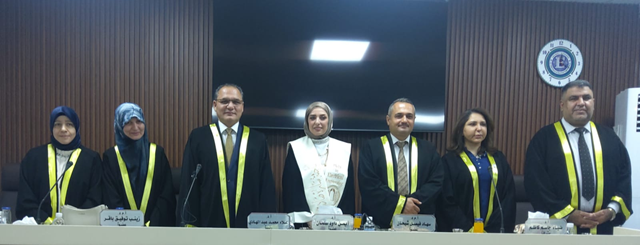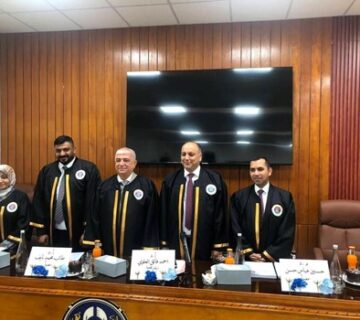

On Tuesday, September 1, 2026, at 9:00 AM, the Smart Hall in the Department of Electrical Engineering at the College of Engineering, University of Baghdad, hosted the PhD dissertation defense of student Sara Sadiq Jawad, titled: “Network Traffic Management Using Artificial Intelligence Technology,” conducted under the supervision of Prof. Dr. Dheyaa Jasim Kadhim.
The study highlighted the paramount importance of data traffic management in Software-Defined Networks (SDN), given its role in enhancing network efficiency and adapting to the continuous surge in demand for modern applications. The researcher presented how integrating artificial intelligence into SDN controllers provides analytical capabilities and a proactive response that improves Quality of Service (QoS), prevents congestion, and ensures balanced load distribution, thereby supporting vital technologies such as the Internet of Things (IoT), Edge Computing, and Data Center Networks.
The scientific significance of the dissertation lies in offering a proactive predictive framework that goes beyond traditional solutions, which rely on reactive approaches after congestion occurs. The work included the study of two types of dataset options: the periodic “Milano” data, and the “MAWI” data representing sudden and intermittent traffic. The researcher successfully developed a “cross-dataset adaptation layer” to bridge the domain gap between MAWI data and the Mininet network simulation environment, enabling the real-time application of a Bidirectional Gated Recurrent Unit (BiGRU) deep learning model across four sequential phases: sensing, prediction, decision-making, and rerouting.
Practical results of the proposed system demonstrated its ability to prevent congestion and predict short-term changes, as the BiGRU-based model achieved a 26.5% improvement in throughput compared to traditional systems, along with a 25% increase in link utilization and a 62.5% reduction in path-switching operations, reflecting higher network stability and responsiveness.