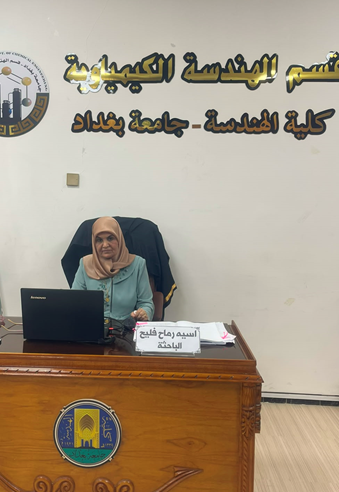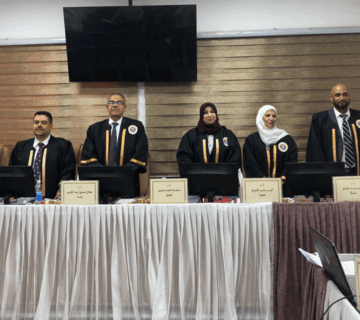
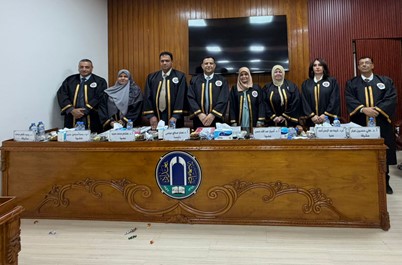
The Chemical Engineering Department at the College of Engineering, University of Baghdad, held a PhD dissertation examination titled:
Activated Carbon-Supported Fe/Ce Catalyst for Heterogeneous Electro-Fenton Treatment of Petroleum Refinery Wastewater
By the student “Asyah Rammah Flayyih” and supervised by Prof. Dr. Wadood T. Mohammed and Prof. Dr. Ali H. Abbar. The examination committee consisted of Prof. Dr. Ammar S. Abbas as Chairman and the membership of Prof. Dr. Hisham M. Majeed , Prof. Dr. Asrar A. Hassan, Ass. Prof. Dr. Basma A. Hussein, and Ass. Prof. Dr. Shaymaa A. Ahmed. The thesis was accepted after conducting a public discussion and listening to the student’s defense. The thesis was summarized as follows:
The aim of study:
- Prepare a novel heterogeneous electro-Fenton (HEF) catalyst comprising Fe@Fe2O3 and CeO2 supported on activated carbon (AC), and comprehensively evaluate its structural, textural, and chemical properties. The catalytic activity will be evaluated by measuring methylene blue (MB) degradation across varying Fe/Ce molar ratios on a fixed AC support to determine the optimal composition.
- Design the HEF Reactor System: Develop and fabricate an innovative electro-Fenton system optimized for hazardous industrial wastewater treatment.
- Optimize Operational Parameters via RSM: Investigate the effects of key operating variables, specifically current density, initial pH, and catalyst dosage on chemical oxygen demand (COD) removal using Response Surface Methodology (RSM).
- Evaluate Stability, Mechanisms, and Kinetics: Assess the reusability and operational stability of the catalyst over multiple cycles, identify the dominant reactive oxygen species (ROS) driving organic degradation via scavenger experiments, and establish the degradation kinetics for COD reduction.
Abstract:
Petroleum refinery wastewater (PRW) is considered one of the most hazardous industrial effluents due to its complex structure, high toxicity, and significant concentration of refractory organic contaminants. In the present work, the removal of chemical oxygen demand (COD) from PRW by a heterogeneous electro-Fenton (HEF) process was investigated using a composite catalyst prepared by combining the high surface area and adsorption capacity of activated carbon (AC) with the catalytic activity of Fe@Fe2O3 and the redox properties of cerium oxide (CeO2).
Different molar ratios of Fe/Ce (1:1, 2:1, and 4:1) loaded on a fixed amount of AC were evaluated, and the catalytic properties were characterized using XRD, BET, FTIR, SEM, and EDS techniques. The XRD results showed no sharp peak in the 2θ range of 20°–30°, confirming the dominance of amorphous carbon, while EDS confirmed the presence of Fe and Ce. SEM images verified that Fe@Fe2O3 and CeO2 particles were immobilized on the surface and within the pores of the AC matrix across all Fe/Ce ratios.
The activity of the prepared catalysts was screened by their ability to degrade 50 mg/L of methylene blue (MB) at 20 mA/cm2 and pH 3 for 150 min in an HEF system. The AC+Fe/Ce (2:1) catalyst exhibited the highest MB removal efficiency at 91%, demonstrating significant synergy between Fe and Ce at this molar ratio.
The application of the optimal catalyst in treating real PRW was investigated by evaluating key HEF operational parameters, current density (5–15 mA/cm2), pH (3–9), and catalyst dosage (0.5–1.5 g/L) on COD removal efficiency using response surface methodology (RSM). The results confirmed that catalyst dosage exerted the main effect on COD removal, followed by pH and current density. The maximum COD removal efficiency of 88.92% was achieved under optimal conditions of 10.96 mA/cm2 current density, pH 5, 0.76 g/L catalyst dosage, and 120 min reaction time, yielding a low total electrical energy consumption of 3.43 kWh/m3.
Scavenger experiments using 5 mM tert-butyl alcohol (TBA), 5 mM ethanol (EtOH), and 10 mM p-benzoquinone (p-BQ) identified hydroxyl radicals (OH•) as the dominant oxidizing species in the HEF reaction. Recyclability and stability tests demonstrated that COD removal efficiency decreased only slightly from 88.92% to 81.3% after 5 consecutive cycles, approving the catalyst’s durability.
Kinetic analysis showed that COD decay obeys pseudo-first-order kinetics with regression fitting (R2) non-less than 0.97. The apparent rate constant (kapp) reached 0.01738 min-1 at 10 mA/cm2 current density and at 1 g/L catalyst dosage before declining at higher values, whereas increasing pH exhibited an adverse effect, recording its maximum kapp of 0.0188538 min-1 at pH 3. Overall, the synergistic combination of Fe and Ce loaded on AC offers a highly promising HEF catalyst for treating complex industrial effluents such as petroleum refinery wastewater.