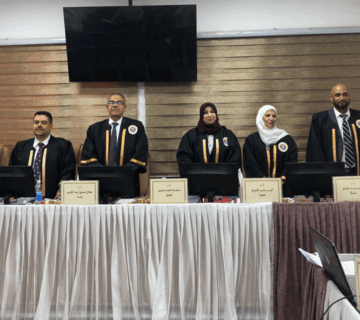

The Water Resources Engineering Department at the College of Engineering, University of Baghdad, held a public defense on Wednesday, September 2, 2026, for the Master’s thesis submitted by M.Sc. student Naba Ayad Haleem, entitled:
“Impact of Lining in Bani Hassan Irrigation Canal on Hydraulic Performance and Water Quality”
The thesis defense was held in the Discussion Hall of the Water Resources Engineering Department, in the presence of several faculty members, researchers, and postgraduate students.
The discussion committee consisted of Prof. Dr. Raad H. Al-Hubbi, Chair, and members Assist. Prof. Dr. Haider Qais and Assist. Prof. Dr. Alaa Hassan. The thesis was supervised by Assist. Prof. Dr. Ali Imran and Assist. Prof. Dr. Ameen Mohammed Saleh.
The study generally aimed to evaluate the impact of canal lining on seepage water losses, hydraulic performance, and irrigation water quality. The study objectives were achieved through the following approaches:
- Investigating the hydraulic performance of the lined and unlined sections of the selected irrigation canal using a one-dimensional hydraulic simulation model (HEC-RAS).
- Evaluating irrigation water quality based on selected physical and chemical parameters using Water Quality Indices (WQI).
- Improving the hydraulic performance and water quality of the canal using two lining alternatives: concrete lining and concrete quilt lining.
The results demonstrated that lining irrigation canals plays an important role in improving the hydraulic performance and water quality of the Bani Hassan Irrigation Canal. The study employed HEC-RAS Version 6.6 to develop one-dimensional hydraulic and water-quality models. Based on the results obtained, the following conclusions were reached:
- The Manning’s roughness coefficient for the concrete lining was relatively low (n = 0.0155), indicating an inverse relationship between surface friction and Manning’s coefficient. The lower value of n results in lower resistance to flow.
- Comparison of the three scenarios showed that concrete lining produced a more stable and consistent flow velocity of 97 m/s, compared with 0.84 m/s for the unlined section and 0.78 m/s for the section lined with concrete quilt.
- The results also demonstrated that lining played a significant role in reducing seepage losses. The use of concrete quilt lining reduced seepage by 93% compared with the unlined canal, while conventional concrete lining reduced seepage by 87%. Accordingly, the concrete quilt provided the highest reduction in seepage losses among the three scenarios.
- Based on the calibration of the water-quality model using Total Dissolved Solids (TDS), the lowest dispersion coefficient was recorded for the concrete-lined section (17 m²/s), followed by the concrete-quilt-lined section (23 m²/s), while the unlined section recorded the highest value (26 m²/s).
- The Water Quality Index (WQI) results indicated that water samples collected from all three sections and under all three tests fell within the “Good” classification, with values ranging from 35 to 47.48. More specifically, the concrete-lined section achieved the highest water-quality performance compared with the concrete-quilt-lined and unlined sections.
- The results showed that canal lining improved both hydraulic performance and water quality. The use of concrete quilt lining significantly reduced seepage losses, while conventional concrete lining provided better hydraulic performance by increasing flow velocity and improving water conveyance efficiency due to its lower roughness coefficient. It also contributed to improved water-quality conditions.
Based on the model results, discussions, and conclusions presented in the thesis, the study proposed several recommendations:
- Future studies should focus on evaluating the hydraulic performance and water quality of the canal under different discharge rates and seasonal conditions to obtain a comprehensive understanding of its behavior.
- Further investigation should be conducted into sediment transport in the unlined section of the Bani Hassan Irrigation Canal.
- Developing a modeling approach based on unsteady two-dimensional simulations would provide a more comprehensive understanding of canal behavior under different operating conditions.
At the conclusion of the defense, following the student’s presentation and the committee’s discussion of her thesis, the committee recommended awarding M.Sc. student Naba Ayad Haleem the Master’s degree with a Very Good (High) grade, wishing her continued success and achievement in her academic and research career.