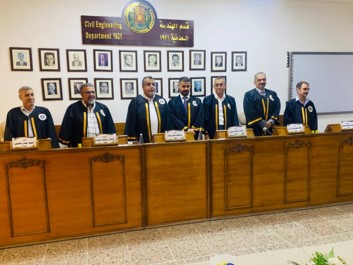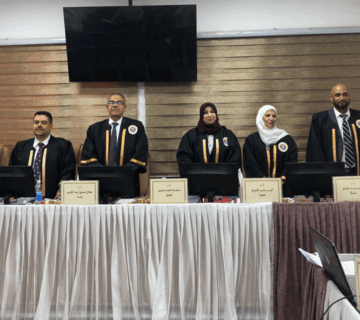
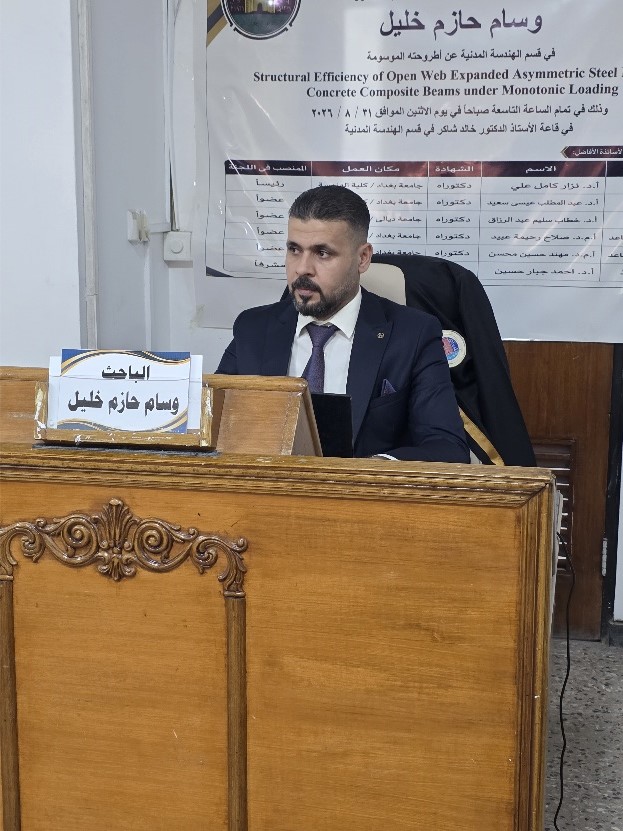
The College of Engineering at the University of Baghdad held a public defense for PhD candidate Wisam Hazim Khalil from the Department of Civil Engineering, who presented his dissertation entitled “Structural Efficiency of Composite Beams Made of Concrete and Asymmetric Steel Sections with Expanded Open Web under Monotonic Loading.” The defense was held on Monday, August 31, 2026, at the Dr. Khalid Shakir Hall, under the supervision of Prof. Dr. Ahmed Jabbar Hussein.
The study evaluated an innovative fabrication technique for developing asymmetric expanded steel sections. This was achieved by using two separate T-shaped structural sections cut from standard hot-rolled IPE 180 and IPE 200 sections for the upper and lower flanges, respectively. The two sections were connected using steel plates to increase the web depth. Two alternative connection configurations were investigated: the first employed 3 mm-thick double-sided plates on both sides of the web, while the second used a single 6 mm-thick central plate, approximately equal to the web thickness of the original asymmetric sections. Through these configurations, web expansion ratios of 30%, 50%, and 70% of the reference total depth were achieved and analyzed.
Comprehensive experimental and numerical analyses were conducted to evaluate the structural behavior of composite concrete–steel beams incorporating asymmetric expanded steel sections. The specimens were tested under a four-point symmetrical bending configuration over a clear span of 2,500 mm to assess the structural performance of these beam systems.
The first part of the research involved an experimental investigation in which sixteen specimens were fabricated and tested. These included one unexpanded specimen and fifteen composite concrete–steel beams with asymmetric steel sections and web expansion ratios of 30%, 50%, and 70%. In the second part, the experimental results were first validated using finite element (FE) numerical modelling through the ABAQUS software. A new numerical model was then analyzed by incorporating additional variables, allowing further models to be developed at a lower cost.
The experimental results demonstrated that increasing the web expansion ratio significantly improved the load-carrying capacity of the specimens by 82.3%, 113.4%, and 117.4% for web expansion ratios of 30%, 50%, and 70%, respectively, compared with the unexpanded specimen.
Regarding the use of curvature in the lower steel section, in addition to improving the ultimate load capacity, it also increased the deformation capacity at the ultimate state by 12.23%, 2.25%, and 32.48%, respectively.
Following the scientific discussion by the members of the examination committee, the candidate’s defense, and the evaluation of the dissertation, the researcher was awarded a PhD degree in Civil Engineering / Structural Engineering.