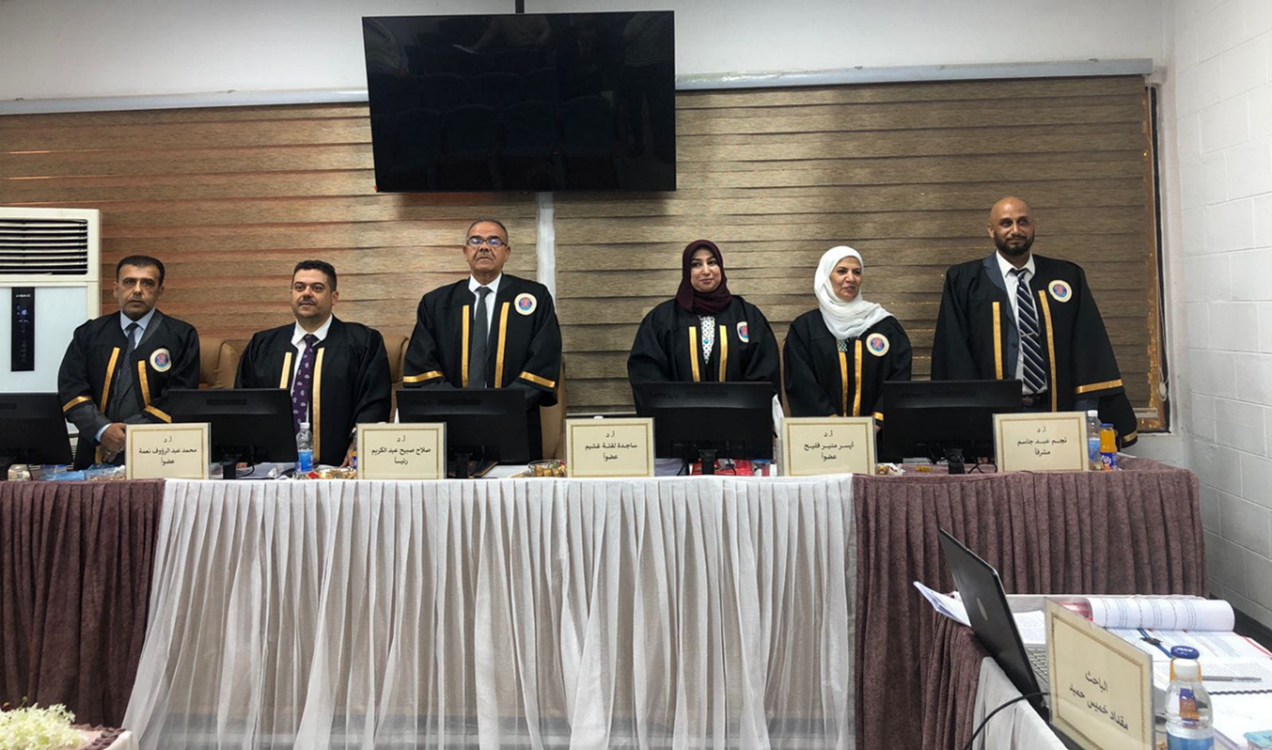
The College of Engineering at the University of Baghdad held a public PhD dissertation defense for Muqdad Khamees Hameed, a doctoral student in the Department of Mechanical Engineering, specializing in Thermo-Fluids.
The dissertation, entitled:
“Performance of HVAC System Using Heat Recovery Techniques for Building Energy Saving in Iraq Climate” was defended on Wednesday, September 2, 2026, at Professor Dr. Ihsan Yahya Hussein Hall in the Department of Mechanical Engineering.
The examination committee consisted of the following faculty members:
- Dr. Salah Sabeeh Abdul Kareem – Chair.
- Dr. Sajida Lafta Ghashim – Member.
- Dr. Mohammed Abdul Raouf Nima – Member.
- Dr. Aysar Muneer Flayyeh – Member.
- Prof. Dr. Sarmad Aziz Abdul Hussein – Member.
- Dr. Najm Abid Jasim – Supervisor.
Research Objectives and Key Findings
The dissertation presented an experimental investigation into the thermal, energy, and economic performance of an air-to-air heat recovery ventilation system under Baghdad’s winter climatic conditions. The research aimed to reduce energy consumption and enhance the efficiency of heating, ventilation, and air conditioning (HVAC) systems in buildings. The study compared four operating configurations: a conventional ventilation system without heat recovery, a smooth flat-plate heat exchanger, a heat exchanger with semi-spherical dimpled plates, and an advanced heat exchanger incorporating semi-conical dimpled plates. Experimental tests were conducted at ventilation rates of 4, 6, and 8 air changes per hour. The results demonstrated that the advanced heat exchanger with semi-conical dimples significantly enhanced heat transfer performance, increasing peak sensible thermal effectiveness to 72.67%, compared with 54.73% for the smooth flat-plate heat exchanger.
Furthermore, the developed system achieved net electrical energy savings of up to 71.33% compared with the conventional ventilation system without heat recovery. The economic analysis also revealed a minimum simple payback period of 3.858 years when the system operated at six air changes per hour.
Research Recommendations
The dissertation highlighted the importance of integrating heat recovery technologies into HVAC systems and utilizing advanced heat exchanger surface designs to enhance heat transfer and reduce energy consumption. These improvements can contribute to developing more energy-efficient air conditioning systems suitable for Iraq’s climatic conditions. The findings also demonstrated the technical and economic feasibility of using advanced semi-conical dimpled heat exchangers to improve ventilation performance and energy recovery in buildings.