
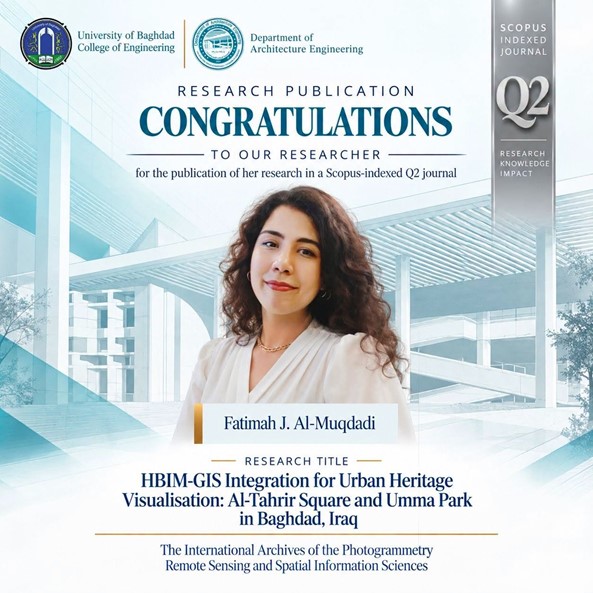
In line with the University of Baghdad’s and the College of Engineering’s commitment to supporting rigorous scientific research and enhancing the presence of academic output in international scientific forums, Assistant Lecturer Fatima Jamal Al-Miqdadi, a faculty member in the Department of Architecture at the College of Engineering, University of Baghdad, has published a scientific research paper entitled “HBIM-GIS Integration for Urban Heritage Visualisation: Al-Tahrir Square and Umma Park in Baghdad, Iraq.”
The research was published in The International Archives of the Photogrammetry, Remote Sensing and Spatial Information Sciences, as part of the proceedings of the 30th CIPA Symposium, entitled “Heritage Conservation from Bits: From Digital Documentation to Data-driven Heritage Conservation,” held in Seoul, South Korea, following a scientific peer-review process.
The study examined the integration of Historic Building Information Modelling (HBIM) and Geographic Information Systems (GIS) for the digital documentation and urban analysis of Al-Tahrir Square and Umma Park in Baghdad, considering them heritage urban spaces that encompass multiple spatial, historical, and social dimensions.
The study relied on a range of sources and technologies, including historical maps and archives, photogrammetry, and satellite imagery, culminating in the development of a multi-scale three-dimensional model that links spatial data with historical and contemporary information.
The methodology consisted of four main stages: data collection; development of a spatial database using GIS; three-dimensional modelling using HBIM; and integration of the two systems within a unified digital environment.
The results demonstrated the potential of digital technologies to produce multi-scale documentation of urban heritage and to connect spatial configurations with urban memory as well as social and historical narratives. The study also highlighted the potential for further developing the methodology toward interactive web-based applications and artificial intelligence technologies, thereby contributing to the support of urban heritage management and enhancing community engagement with heritage sites.


