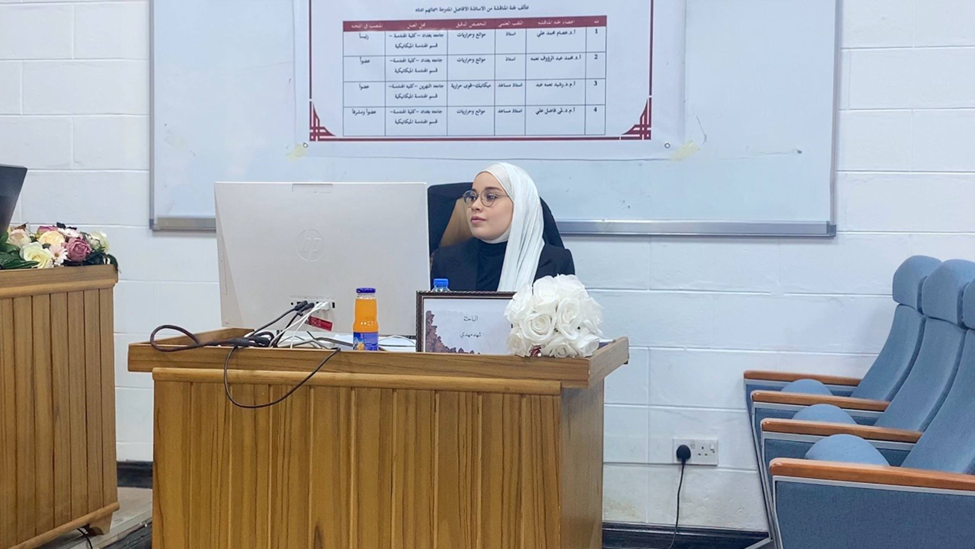
The College of Engineering at the University of Baghdad witnessed the discussion of the Master’s thesis of the student Shahad Mahdi Saleh from the Department of Mechanical Engineering, entitled:
“Investigation of Convection Heat Transfer in an Annular Enclosure Partially Filled with Porous Media.”
The discussion committee consisted of:
- Prof. Dr. Issam Mohammed Ali — Chairman
- Prof. Dr. Mohammed Abdul Raouf Nima Mohammed — Member
- Asst. Prof. Dr. Rasheed Nima Abed — Member
- Asst. Prof. Dr. Luma Fadhil Ali — Member and Supervisor
The thesis investigated natural convection heat transfer within a three-dimensional annular enclosure partially filled with metallic foam. The study focused on the effects of foam distribution, inclination angle, and heat flux on enhancing thermal performance compared to a clear annulus. A combined methodology was adopted, including numerical analysis using ANSYS Fluent and experimental validation.
The results showed that the use of metallic foam significantly enhanced heat transfer performance. The uniform foam distribution achieved the highest improvement in the Nusselt number, ranging between 25% and 55%, while other configurations provided localized enhancements of 20% to 35%. Increasing the heat flux and inclination angle further strengthened natural convection and increased flow velocity inside the enclosure. Experimental results confirmed these findings, with Nusselt number improvements reaching up to 80% under maximum operating conditions. A strong agreement between numerical and experimental results was observed, with a deviation not exceeding 8%.
Recommendations:
- Utilize metallic foam as an effective porous medium to enhance heat transfer in thermal applications.
- Prefer uniform foam distribution within annular enclosures to achieve optimal thermal performance.
- Investigate higher inclination angles and a wider range of heat flux values for improved system efficiency.
- Combine numerical simulations (CFD) with experimental work to ensure result accuracy.
- Apply the study outcomes in the design of heat exchangers and industrial systems relying on natural convection.
Following the scientific discussion, the student was awarded the grade of Very Good.


