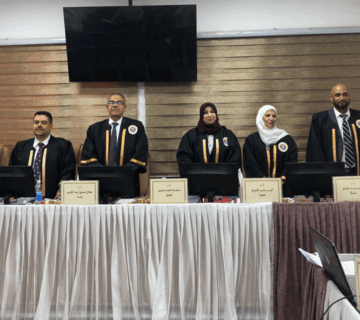
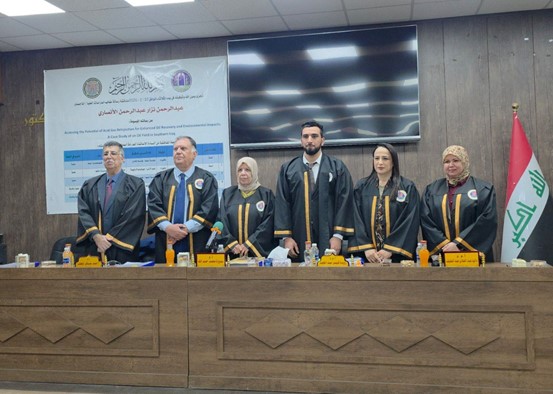
The Master’s thesis of the student Abdulrahman Nizar Abdulrahman was discussed in the Department of Petroleum Engineering on the research entitled:
Assessing of Acid Gases Reinjection for Enhanced Oil Recovery in Ratawi Oil Field
On Tuesday 10/2/2026 the examination committee was composed of:
- Dr. Samira Mohammed Hamdallah
University of Baghdad / College of Engineering / Petroleum Engineering – Chair
- Dr. Ahmed Askar Najaf
Al-Nisour University / College of Engineering / Petroleum Economics – Member
- Prof. Dr. Ruwaida Qaisar Abdulmajeed
University of Baghdad/ College of Engineering / Petroleum Engineering -Member
- Dr. Iyad Abdulhaleem Abdulrazzaq
University of Baghdad / College of Engineering / Petroleum Engineering- Member & Supervisor
- Prof. Dr. Dalia Abdulhadi Abdullatif
University of Baghdad / College of Engineering / Petroleum Engineering -Member & Supervisor
This thesis addressed the challenges of oil production associated with acid gases (H₂S and CO₂) by evaluating the feasibility of reinjecting these gases into the Yamama Formation in the Ratawi oilfield as a dual-purpose strategy for safe disposal and enhanced oil recovery. The study adopted an integrated approach combining petrophysical evaluation, machine-learning-based facies classification, 3D geological modeling, fluid-phase behavior analysis, compositional reservoir simulation, and geochemical reactive modeling. It examined key challenges including miscibility development, asphaltene stability, acid-gas solubility in formation water, and fluid–rock interactions, in addition to assessing advanced scenarios such as separate-well injection of gas and water and the impact of water vaporization on miscible flooding performance and geochemical stability.
The results demonstrated strong reservoir heterogeneity and confirmed the effectiveness of acid gas injection particularly when combined with water injection in improving recovery efficiency, enhancing pressure support, and maintaining stable reservoir performance with minimal geochemical and operational risks. The study is distinguished as the first comprehensive work of its kind on an Iraqi field to address acid gas injection from both engineering and geochemical perspectives, offering a broader and more realistic understanding of the process. Its findings provide practical insights applicable to the future development of the Yamama Formation and similar reservoirs in southern Iraq, where increasing acid gas production necessitates efficient and sustainable management strategies.