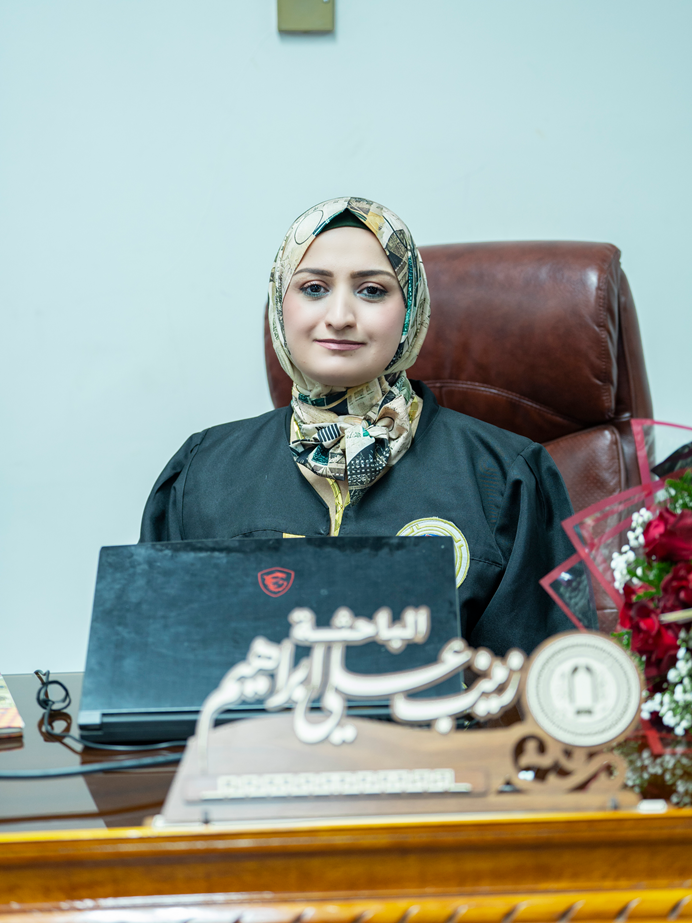
The Chemical Engineering Department at the College of Engineering, University of Baghdad, held a PhD dissertation examination titled:
Synthesis and Characterization of Smart Draw Agents in Forward Osmosis Process
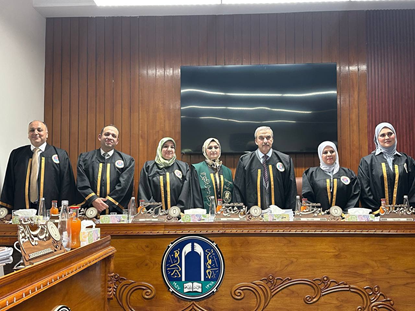
By the student “Zainab Ali Ibrahim” and supervised by Prof. Dr. Ahmed Faiq Al-Alawy. The examination committee consisted of Prof. Dr. Rafie Rushdy Mohammed as Chairman and the membership of Prof. Dr. Ibtehal K. Shakir, Prof. Dr. Sama M. Al-Jubouri, Ass. Prof. Dr.Atheer M. Al-Yaqoobi , and Ass. Prof. Dr. Nada N. Abdulrazzaq. The thesis was accepted after conducting a public discussion and listening to the student’s defense. The thesis was summarized as follows:
The aim of study:
The thesis aimed to prepare and investigate types of smart draw solutions. These included chitosan–magnetite nanocomposites (CS–Fe3O4), silica-coated magnetite nanoparticles (Fe3O4@SiO2) synthesized using different volumes of tetraethyl orthosilicate (TEOS) (10, 20, and 30 mL), and, for the first time, multi-walled carbon nanotubes (MWCNTs) were employed as components of draw solutions. Specifically, potassium-functionalized magnetite incorporated with MWCNTs, denoted as K@Fe3O4(1, 1.5, and 2 g)@MWCNT, was prepared. In addition, triethylene glycol (TEG)-K/MWCNT draw solutions with TEG contents of 5, 10, 15, and 20% were developed. , to assess their performance in recovering pure water from a methylene blue solution using the forward osmosis process with a thin-film composite membrane. Additionally, the effect of draw solution concentration on process efficiency was investigated by measuring water flux and rejection percentage. These smart draw solutions were compared with conventional NaCl in the FO process. The regeneration of diluted smart DSs to extract pure water through the photothermal process and an external magnetic field was also investigated. A mathematical model of the FO system was made, where the theoretical and experimental results were compared.
Abstract:
Forward osmosis (FO) is regarded as one of the highly energy-efficient membrane technologies for wastewater treatment and purification, as it operates based on a concentration gradient (osmotic pressure) between feed solution (FS) and draw solution (DS), which acts as a natural driving force for water transport across a semi-permeable membrane, without the need for high hydraulic pressure. The advancement and practical implementation of FO technology depend on the development of suitable draw solutions (DSs) that generate high osmotic pressure, exhibit good chemical stability, facilitate easy and efficient recovery, and exert minimal adverse effects on membrane performance and overall process efficiency.
In this work, synthesized smart draw solutions from different materials for the FO process to recover pure water from water polluted with methylene blue (MB) dye are investigated. Magnetic nanoparticles (MNPs) are ineffective as draw solutions in the FO process because they cannot generate sufficient osmotic pressure (i.e., driving force) to drive the transfer of pure water across the membrane. Therefore, in this study, MNPs were coated with chitosan (CS) and silicon dioxide (SiO2) materials to synthesize smart draw solutions using the co-precipitation technique.
Also, dual-functioned potassium-doped multiwalled carbon nanotube (K/MWCNT) in tri-ethylene glycol (TEG) as TEG-K/MWCNT and with Fe3O4 as K@Fe3O4@MWCNT were prepared as novel draw solutions. These prepared draw solutions (DSs) enhance the performance of the FO process across a thin film composite (TFC) membrane by augmenting both flux and rejection percentage, and then are compared with the performance of a conventional NaCl draw solution.
Investigations were conducted to determine the effects of the manufactured draw solutions types at concentrations from 1 to 4 g/L of K@Fe3O4(1g)@MWCNT, K@Fe3O4(1.5g)@MWCNT, K@Fe3O4(2g)@MWCNT, CS-Fe3O4, Fe3O4@SiO2 10 mL tetraethyl orthosilicate (TEOS), Fe3O4@SiO2 20 mL TEOS, Fe3O4@SiO2 30 mL TEOS and 1, 2 g/L concentrations of TEG(5%)-K/MWCNT, TEG(10%)-K/MWCNT, TEG(15%)-K/MWCNT, TEG(20%)-K/MWCNT on water flux and rejection percentage. These draw solutions were compared with conventional NaCl DS at 5, 10, 20, 35, and 70 g/L concentrations in the FO process.
The stability, crystalline morphology, shape, and size of the synthesized nanoparticles were examined using different testing methods, including XRD, AFM, FESEM, EDS, FTIR, TEM, and zeta potential analysis. These analyses validated the practical synthesis and suitability of the materials for FO application.
The results indicated that rejection and flux increased with higher DS concentration and decreased over time. The highest water flux of the FO process was 10.97, 10.3, and 9.58 LMH for CS-Fe3O4, Fe3O4@SiO2 20 mL TEOS, and K@Fe3O4(2g)@MWCNT, respectively, at 4 g/L concentration DS, and 7.9 LMH by using TEG(15%)-K/MWCNT at 2 g/L concentration compared with 9.52 LMH of NaCl at 70 g/L, and the higher rejection efficiency of 20 ppm of MB as FS was higher than 99 %.
The regeneration process of CS-Fe3O4, Fe3O4@SiO2 10, 20, 30 mLTEOS and K@Fe3O4@MWCNT DSs was readily separable from the diluted DS by the application of a magnetic field. At the same time, the photothermal process was used to regenerate the dilute TEG-K/MWCNT DS.
A mathematical model was developed for the flat sheet to predict the water flux theoretically using different NaCl DS concentrations in FO mode; the accuracy ranges from 41.14 to 58.35%. There was a good agreement between the experimental and theoretical results obtained from the mathematical model. The correlation coefficient (R2) is 98.89%.