\
Sustainable Development – Responsible Consumption and Production
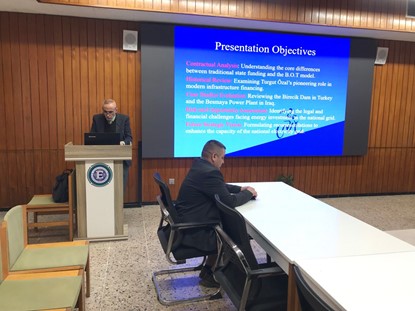
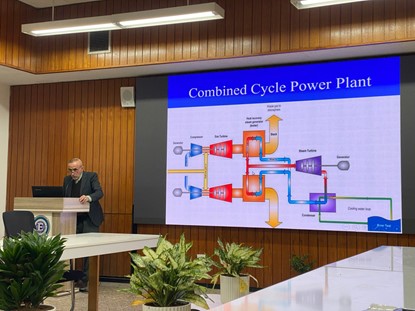
The Department of Electrical Engineering at the College of Engineering, University of Baghdad, in cooperation with the Continuing Education Unit, organized a specialized workshop on Monday, February 23, 2026, entitled “The Impact of Using BOT Contracts on Increasing the Capacity of the Iraqi National Power Grid.” The workshop was attended by the Head of the Department, Professor Dr. Firas Mohammed Tuayma, along with several faculty members, and was held in the department’s meeting hall.
The workshop was delivered by Assistant Lecturer Hussein Alawi Salim, who reviewed the major challenges facing Iraq in achieving stability of the national power grid. He emphasized the urgent need to establish new power plants to bridge the growing production deficit. The session highlighted the Build-Operate-Transfer (BOT) model as a strategic solution based on three main phases: the investor finances and constructs the project at their own expense; the operation phase during which the project is managed to recover costs and generate profit within an agreed concession period; and finally, the transfer of ownership to the state after the specified term. This mechanism ensures the addition of new generation capacities without imposing direct financial burdens on the state treasury.
The lecturer also presented applied models analyzing the efficiency of such contracts, including the Turkish experience at the Birecik Dam hydroelectric power plant, whose ownership reverted to the state after the concession period, representing a successful model in renewable energy projects.
In addition, he addressed the Bismayah Power Plant project under a Build-Own-Operate (BOO) contract, highlighting the role of modern technology in providing substantial generation capacity. He noted, however, that this model does not stipulate the transfer of ownership to the state, which may result in long-term financial obligations.
The workshop concluded with several recommendations emphasizing the adoption of BOT contracts as an effective public–private partnership model and the gradual expansion of their application in renewable energy projects, particularly solar and hydropower. It also stressed the importance of implementing a strict regulatory system to monitor the efficiency of privately operated power plants, ensuring the stability and enhanced capacity of the national electricity grid.