
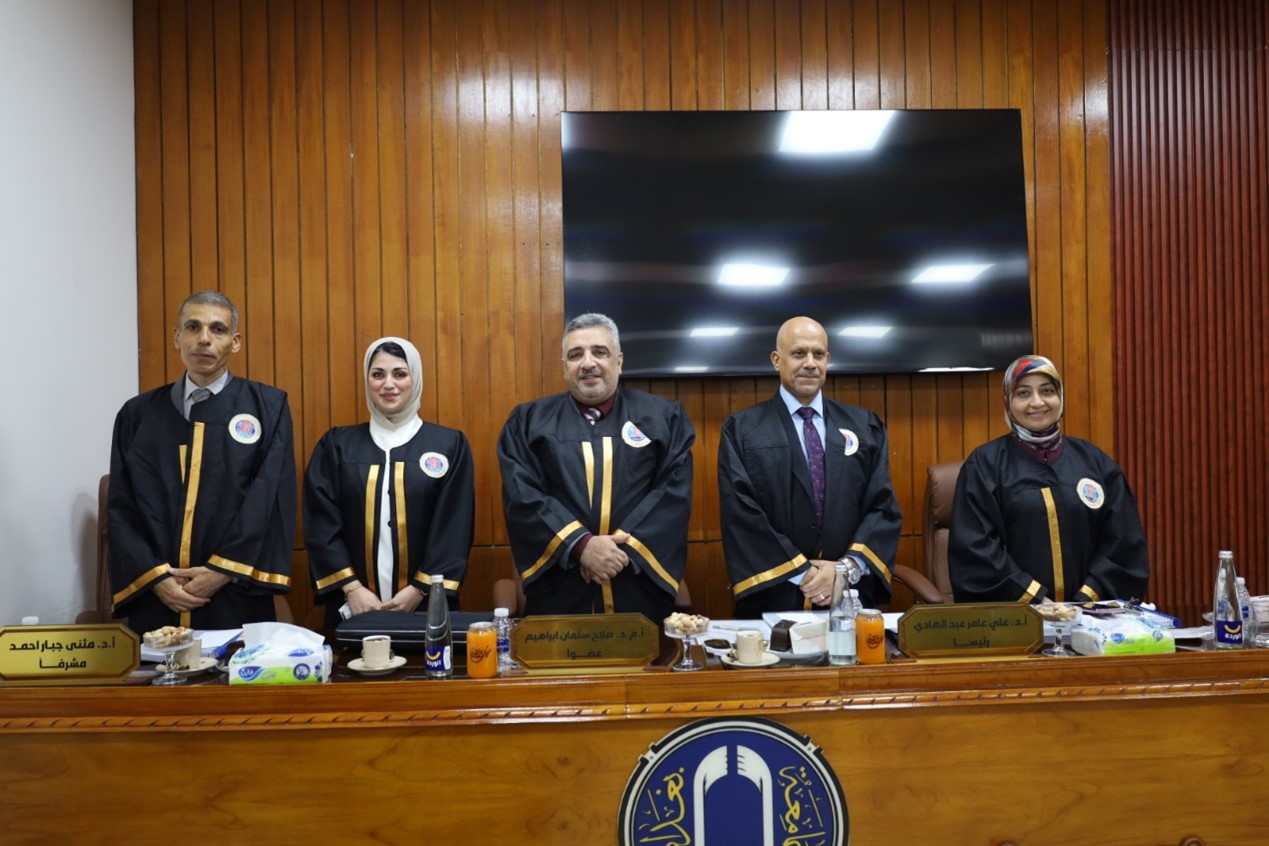
The College of Engineering at the University of Baghdad witnessed the public defense of the master’s thesis by Rana Raad Yousif in the Department of Chemical Engineering. Her thesis, titled “Preparation of Activated Carbon and Biochar from Barley Straws for the Adsorption of Bisphenol A” was presented on Sunday, 23 August 2026, in Professor Mahmoud Omar Hall within the Department of Chemical Engineering, under the supervision of Prof. Dr. Muthanna J. Ahmed.
Emerging contaminants pose major environmental challenges due to their widespread occurrence and resistance to conventional treatment. Bisphenol A (BPA) is a significant contaminant widely used in plastics and associated with potential health and environmental risks, even at low concentrations.
This study aimed to prepare activated carbon (AC) and biochar (BC) from barley straws residues and evaluate their efficiency in removing BPA from aqueous solutions. It also aimed to optimize the preparation conditions of AC and investigate its physical, chemical, and adsorption properties.
Activated carbon was produced by chemical activation using potassium hydroxide (KOH), biochar was prepared using pyrolysis. The optimal conditions for preparation were determined by studying the effect of carbonization temperature, carbonization time, and impregnation ratio. Adsorbent materials were characterized using BET, SEM and FTIR techniques. In addition, the effect of pH, initial BPA concentration, contact time, and temperature on adsorption efficiency were studied, with equilibrium, kinetics, and thermodynamics models applied to explain adsorption behavior and mechanism.
The results showed that chemical activation led to a significant improvement in the properties of activated carbon, with a specific surface area of 1116.47 m²/g compared to 675.70 m²/g for biochar, and the porous volume increased significantly, reflecting a higher adsorption efficiency. Activated carbon achieved the best performance at pH = 7, while the Langmuir model was the most consistent with equilibrium data (maximum adsorption capacity (qmax) = 555.56 and 135.14 mg/g for activated carbon and biochar, respectively).
Furthermore, the best agreement with the experimental data was pseudo-second-order model. While Weber–Morris model showed that the adsorption process takes place through more than one stage thus, the adsorption rate is not solely controlled by the pore diffusion mechanism. Thermodynamic analyses showed that adsorption is an endothermic reaction and becomes more suitable as the temperature rises. Based on the results of the characterization and equilibrium, kinetics and thermodynamic studies, an integrated adsorption mechanism based on the synergy of several mechanisms was proposed, including hydrogen bonds, π–π interactions, van der Waal forces, diffusion within pores, pore filling, and electrostatic interactions.
The results confirm that activated carbon prepared from barley straws is a highly efficient, low-cost, environmentally friendly that can be a promising alternative to commercial adsorbents in the removal of bisphenol A and other pollutants originating from water.


