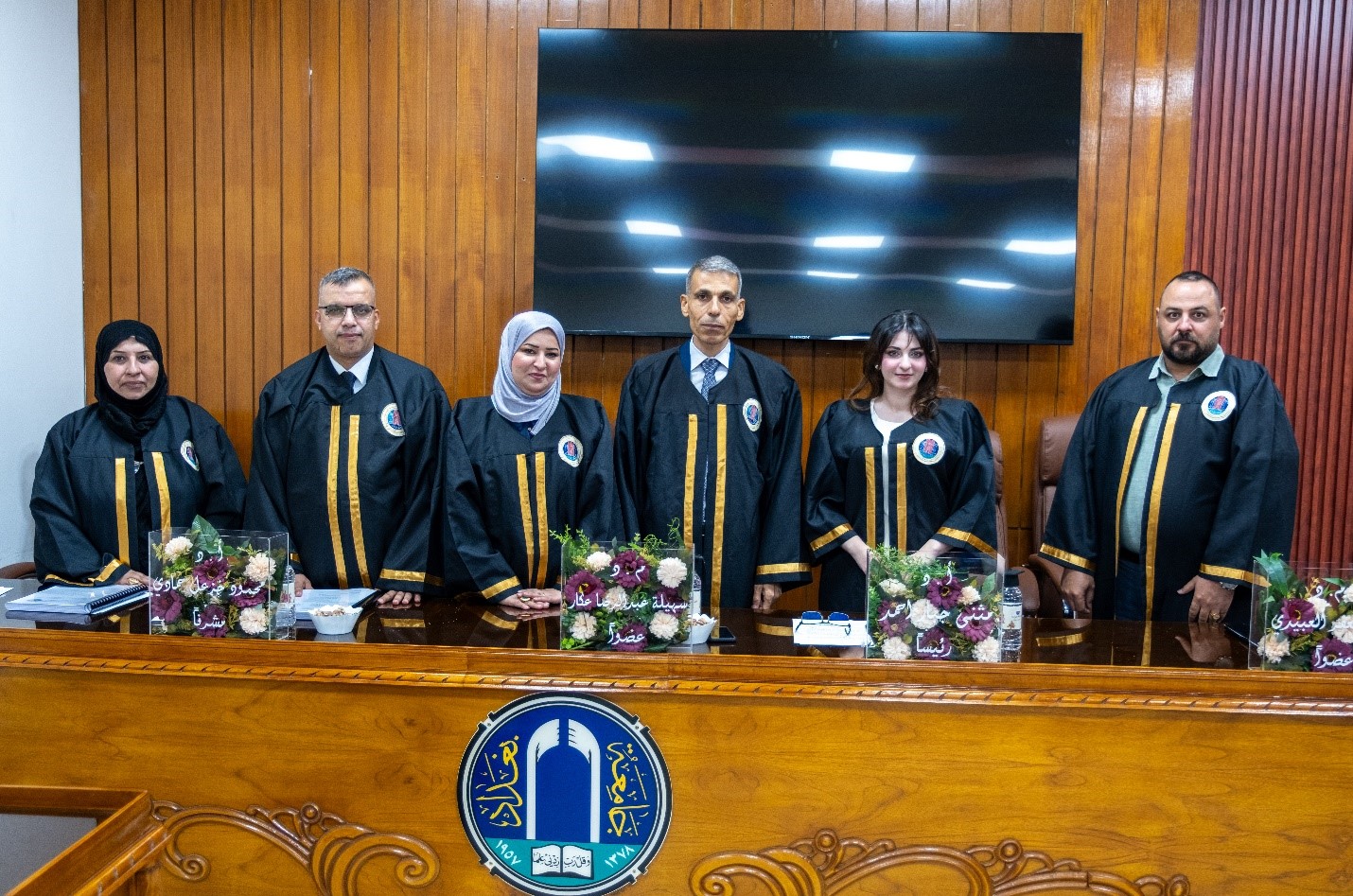
The College of Engineering at the University of Baghdad witnessed the public defense of the master’s thesis by Haya Musab Zobeer in the Department of Chemical Engineering. Her thesis, titled “Preparation and characterization of chemically crosslinked gelatin adsorbents for sunset yellow dye removal from aqueous solutions” was presented on Wednesday, 9 September 2026, in Professor Mahmoud Omar Hall within the Department of Chemical Engineering, under the supervision of Prof. Dr. Mahmood K. Hummadi and Prof. Dr. Sanaa Abdul Al-Sahib.
Synthetic azo dyes such as Sunset Yellow (SY) are increasingly released into aquatic environments, causing environmental and health concerns and creating a demand for low-cost and eco-friendly adsorbents to remove these dyes from water. This work focused on chemically crosslinked gelatin (with glutaraldehyde (GTA-GE) and formaldehyde (FA-GE)) to enhance the structural stability, degradation resistance, and mechanical properties of the biodegradable material.
The adsorbents were characterized by FTIR, which confirmed successful crosslinking through the changes in the amide and N–H bands, and by SEM/EDX, which revealed a smooth surface morphology after crosslinking. BET analysis showed a marked increase in specific surface area upon crosslinking, from 4.559 m²/g for uncrosslinked gelatin to 8.325 m²/g for FA-GE and 22.603 m²/g for GTA-GE.
The adsorption efficiency was evaluated for the various pH, dosage, contact time, initial dye concentration, and temperatures. The best amount of removal was achieved at pH 4 at a dosage of 0.1 g/50 mL and an initial concentration from 10 mg/L to 50 mg/L. Equilibrium was reached within 80 min for both gelatin and GTA-GE, and within 100 min for FA-GE. The maximum efficiencies obtained were 99.8% for GTA-GE and 96% for both gelatin and FA-GE.
Swelling tests revealed a significant difference between the two crosslinked adsorbents: GTA-GE showed an equilibrium swelling ratio of about 672% after approximately 600 minutes, while FA-GE reached equilibrium earlier (360 min) but at a significantly lower ratio (~176%).
Kinetic analysis fit the pseudo-second order model, and the equilibrium data were found to follow the Freundlich isotherm (R² up to 0.995), indicating that multilayer adsorption was favorable on a heterogeneous surface (n > 1). The Langmuir model gave maximum monolayer adsorption capacities (qmax) at 338 K of 36.23 mg/g for GTA-GE and 29.59 mg/g for FA-GE. Thermodynamic calculations indicate that the process was exothermic and spontaneous. The regeneration tests indicated that GTA-GE lost its effectiveness after 4 cycles (95.9% to 77.9%), while FA-GE was still usable after 3 cycles (93.3% to 72.5%).
Overall, crosslinked gelatin, particularly GTA-GE, shows strong promise as a sustainable, eco-friendly, and reusable adsorbent for removing SY from contaminated water.


