
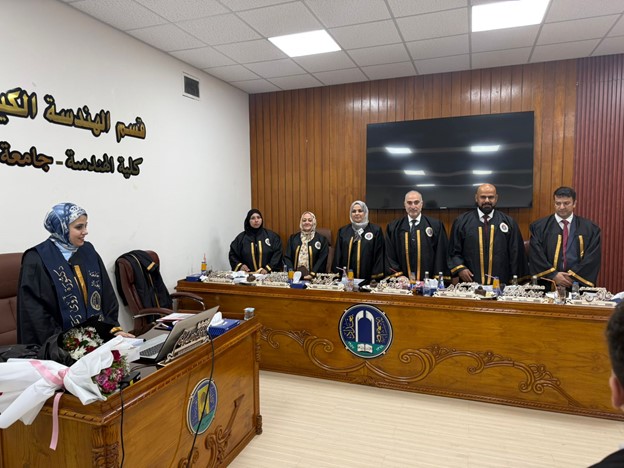
The Chemical Engineering Department at the College of Engineering, University of Baghdad, held a PhD dissertation examination titled:
Synthesis and Characterization of Eco-friendly Chitosan/CuO Nanocomposite for the Removal of Lead (II) from Industrial Wastewater
By the student “Arwa Raad Ibrahim” and supervised by Prof. Dr. Basma Abbas Abdulmajeed. And Prof. Dr. Sanaa A. Al-sahib. The examination committee consisted of Prof. Dr. Hasan Farhood Makki as Chairman and the membership of Prof. Dr. Ahmed Daham Wiheeb, Prof. Dr. Haider A. Al-Jendeel, Prof. Dr. Khalid M. Abed, Asst. Prof. Dr. Samar Kareem Theydan. The thesis was accepted after conducting a public discussion and listening to the student’s defense. The thesis was summarized as follows:
Abstract
The accelerated development of innovative technologies for the removal of lead (II) has led to the emergence of numerous innovative adsorbents. These materials typically possess promising structural and surface properties suitable for a variety of applications. In the same context, the present study developed three new nanocomposites (Chitosan-based on pyromellitic dianhydride and copper oxide (PMDA-CTs-Cu); Chitosan-based glutaraldehyde pyromellitic dianhydride and copper oxide (CT-GLA-PD-Cu), and quinoline-2-carbonyl Chitosan-copper oxide (Q-CT-Cu) for lead (II) removal. The adsorbents were strategically designed through multiple stages to optimize compatibility under operating conditions.
Key modifications included sequential chemical remodeling to form functional groups under ultrasonic wave conditions. The successful incorporation of these functional groups and the creation of a porous and thermally stable material were confirmed using advanced characterization techniques: Fourier Transform Infrared Spectrometer (FTIR), Field-Emission Scanning Electron Microscopy (FESEM), X-ray Spectroscopy (EDX), X-ray Diffraction (XRD), and Thermogravimetric Analyzer (TGA). The results proved that the modifications significantly enhanced the chemical structure and surface morphology for all the samples. The lead (II) removal efficiency of the prepared adsorbents was verified in batch adsorption process. The removal efficiency varied, with Q-2-CTs (57.8%), Q-2-CTs-CuO (88.7%), CT-GLA-PD (71.7%), CT-GLA-PD-Cu (89.3%), PMDA-CTs (67.3%), and 95% for PMDA-CTs-CuO. Based on the removal efficiency (95%), productivity (96%), thermal stability, low preparation cost under acceptable operating conditions, the prepared material (PMDA-CTs-Cu) was selected as the best prepared materials for further kinetic, isotherm, and thermodynamic studies. The adsorption performance of this adsorbent was evaluated as a function of pH, adsorbent dosage, and equilibrium time. The optimum conditions were achieved at pH 2, and adsorbent dosage of 0.05 g, and an equilibrium time of 120 min.
The results showed that the pseudo-second-order model is suitable to describe the kinetic study of lead (II) on the PMDA-CTs-Cu under surface interaction behavior. The adsorption data indicated that the diffusion within the pores is an element of the adsorption process, although it is not the determining factor, according to the intraparticle diffusion model. In addition, as the initial concentration of lead (II) rises, the adsorbent internal resistance weakens, and a stronger driving force is generated for the diffusion of lead ions into its pores. Furthermore, mass transfer is frequently enhanced by the surrounding membrane, as experimental data are consistent with the boyd external kinetic model, indicating that adsorption occurs via multiple interrelated pathways. Avrami’s model also supports these findings, demonstrating that adsorption process is multi-mechanistic. The results indicate that the process is controlled by interaction process of the surface between the adsorbent and the lead (II). However, this adsorption may be complex and vary in activation energy, governed by influence of the initial concentration factor as confirmed by Elovich model. The Langmuir model provided a good representation of the adsorption process according to R-squared value with maximum adsorption capacity 128.21 mg/g. However, the lower Root Mean Square Error (RMSE) and Mean Absolute Error (MAE) values suggested that the Freundlich model provided more accurate predictions. Thus, there is a slight degree of surface heterogeneity and some variation in surface adsorption energies. This indicates that both models adequately described the adsorption behavior from different statistical perspectives. The process was also described thermodynamically, and it was shown that the adsorption is spontaneous and endothermic with an insignificant degree of randomness.