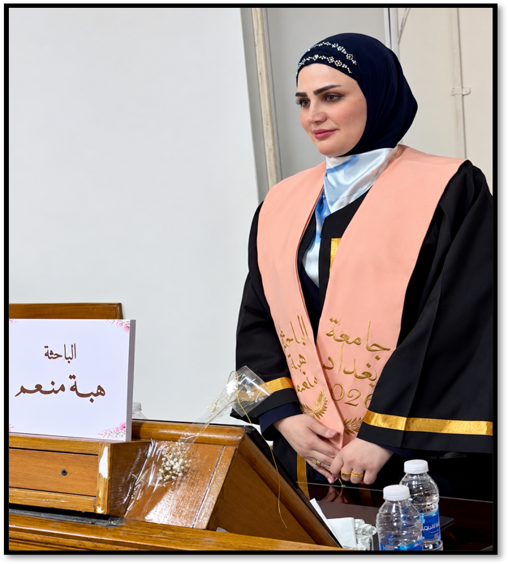
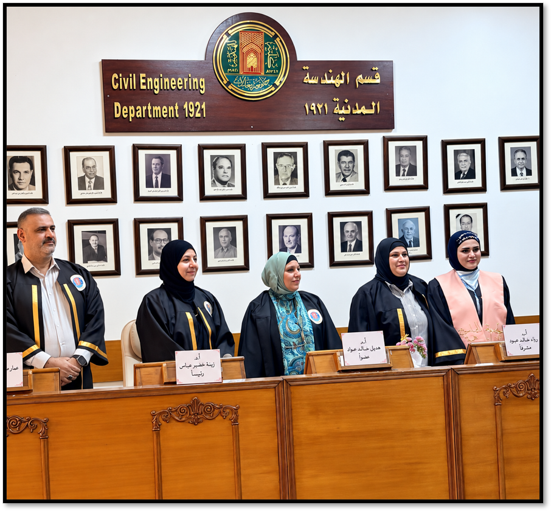
The College of Engineering at the University of Baghdad held the public defense of a Master’s thesis submitted by Hiba Munaim, from the Department of Civil Engineering, entitled “Effect of Fire Flame on Some Properties of Structural Lightweight Self-Compacting Concrete.” The defense was held on Thursday, August 13, 2026, in the Prof. Dr. Khalid Shakir Hall at the College of Engineering, University of Baghdad, under the supervision of Assist. Prof. Rawaa Khalid Aboud.
The thesis aimed to investigate the effect of direct exposure to fire flame on selected properties of structural lightweight self-compacting concrete. It also examined the possibility of using waste glass as a partial replacement for natural fine aggregate, in addition to evaluating the effect of incorporating 1% micro steel fibers on improving the mechanical properties of concrete and its residual performance after fire exposure. The study also investigated the effects of different cooling methods following exposure to elevated temperatures.
The thesis included the preparation of structural lightweight self-compacting concrete mixtures using 100% pumice as lightweight coarse aggregate, with natural fine aggregate replaced by recycled waste glass at rates of 0%, 20%, 30%, and 40%. Another group of mixtures was prepared with the addition of 1% micro steel fibers. The fresh and hardened properties of the mixtures were evaluated, after which the specimens were exposed to fire flame at temperatures of 300, 400, and 500°C for 60 minutes. The study then investigated the effects of two cooling methods following fire exposure: gradual cooling and foam cooling. Mass loss and the residual mechanical properties of the specimens were also evaluated.
The thesis reached a number of conclusions and recommendations, the most significant of which were:
- The results showed that the use of recycled waste glass improved the flowability and passing ability of the fresh concrete. All mixtures remained within the acceptable limits specified for self-compacting concrete, while the addition of micro steel fibers resulted in a relative reduction in flowability and a slight increase in viscosity.
- A 20% replacement ratio of recycled waste glass achieved the best mechanical performance among the replacement ratios investigated, showing improvements in compressive and flexural strength. The addition of 1% micro steel fibers also contributed to improving the strength of the mixtures and enabled them to retain their residual strength more effectively after fire exposure.
- The results indicated that increasing the fire exposure temperature generally led to greater mass loss and a reduction in the residual strength of the concrete. Foam cooling had a greater effect on reducing residual strength compared with gradual cooling, whereas mixtures containing micro steel fibers demonstrated better performance after fire exposure. Based on the findings, the G20 mixture, containing 20% recycled waste glass, emerged as one of the mixtures with suitable performance within the variables investigated in the study.
The examination committee consisted of Prof. Dr. Zeina Khudair Abbas, Chair; Assist. Prof. Hadeel Khalid Awad, Member; Dr. Ammar Sabah Abdul Amir, Member; and Assist. Prof. Rawaa Khalid Aboud, Supervisor.
Following the scientific discussion by the members of the examination committee, the candidate’s defense, and the evaluation of the thesis, the committee decided to accept the thesis and award Hiba Munaim a Master’s degree in Civil Engineering.