
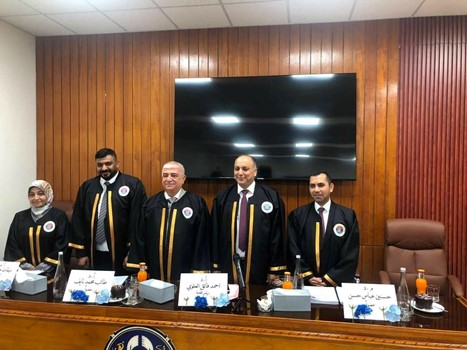
The College of Engineering at the University of Baghdad witnessed the public defense of the master’s thesis by Ali Khalil Ibrahim in the Department of Chemical Engineering. His thesis, titled “Improving The Performance of Reverse Osmosis Desalination System Through Multi-Stage Configurations” was presented on Thursday, 18 August 2026, in Professor Mahmoud Omar Hall within the Department of Chemical Engineering, under the supervision of Asst Prof. Dr. Miqat Hasan Salih.
Climate change, population explosion, and aspirations of a higher standard of living have made it difficult to secure water as an existential resource. Drinking water quality is essential for life, food and agricultural production, industry, and nature. Nevertheless, freshwater demand far exceeds supply, even when all available sources are used (desalination of seawater, brackish water, and wastewater). Reverse osmosis (RO) desalination is an effective way to supply water, allowing hundreds of millions of people to access safe and cheap drinking water.
Lowering specific energy consumption (SEC) in reverse osmosis plants is one of the most important criteria in the water treatment industry. The present work focused on best RO pilot plant configurations for minimizing specific energy consumption, finding the best configurations experimentally to recover the water with minimizing salts in permeate side in RO module, investigating the causes to analyze single and two stage systems, TFC membrane is used in spiral wound with module of Vontron Element TW30-1812 50-Gal production /day (USA) by using brackish water as feed solution with different concentrations (2000, 3000, 4000 and 5000 ppm) in ten RO pilot plant configurations made by conventional design and recycling either permeate or concentrated streams in different ratios, the operational pressure varies between 4-7 bar with feed flowrate of 200 ml/min in both two stages. Additional tests were conducted for S10 with varying operating pressures at a feed concentration of 2000 ppm. According to the results, produced water concentrations increased, and flux decreased as feed concentration rose from 2000 to 5000 mg/L. The experimental work was further applied using a Vontron Element ULP-2012 100-Gal production-in-a-day (USA) module at 2000 ppm, an operating pressure of 3 bar, and a feed flow rate of 300ml/min, with the same RO configurations. Finally, Dual capacity systems between the two modules were established in the RO system with five new configurations, using the same conditions for each module to increase rejection and flux while minimizing SEC. The results showed that permeate concentration increased and flux dropped as the process continued from 0 to 60 min when the concentrated stream was recycled to the feed vessel at any ratio, and vice versa when permeate was recycled.
Best RO system configurations experimental results for SEC are found as S10 by 50-Gal RO module was 0.55, S10 by 100-Gal RO module second stage 0.49, D2 has 0.49, D5 has 0.49, all in kW/m3h. For the flux study, S10 for the 50-Gal RO module at the second stage is 10.623; S10 for the 100-Gal RO module at the second stage is 6 LMH; D2 at the second stage is 5.68; and D5 at the second stage is 16.72 LMH. For rejection study, S10 by 50-Gal RO module second stage has 93%, S10 by 100-Gal RO module second stage was 96.46%, D2 second stage has 93.93%, D5 second stage has 95.60%
D2 exhibits the optimal configuration across all systems tested at a concentration of 2000 ppm, according to SEC reduction with concentrate recycle; however, product water quality remains a limitation, so the priority needs to be application-driven for utilization of produced water. e.g., D5 shows significantly better results than under extremely low salinity in boiler feedwater.


