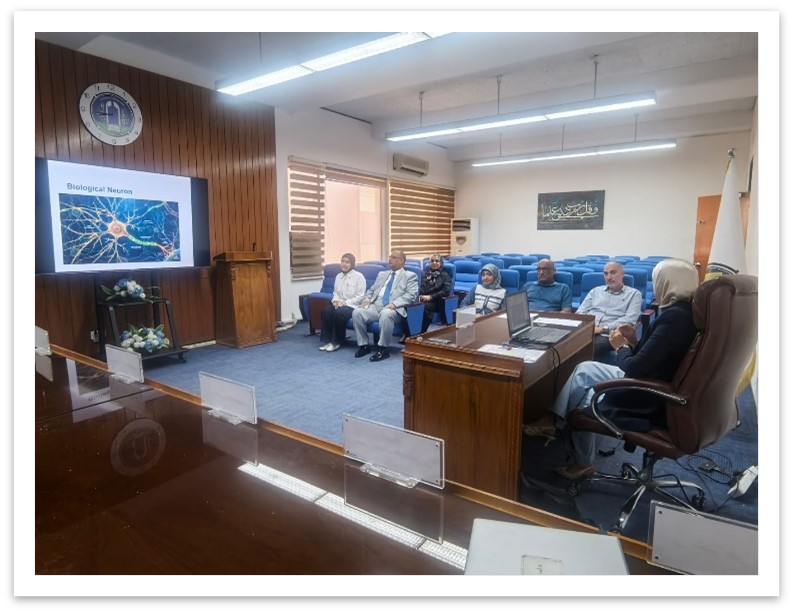
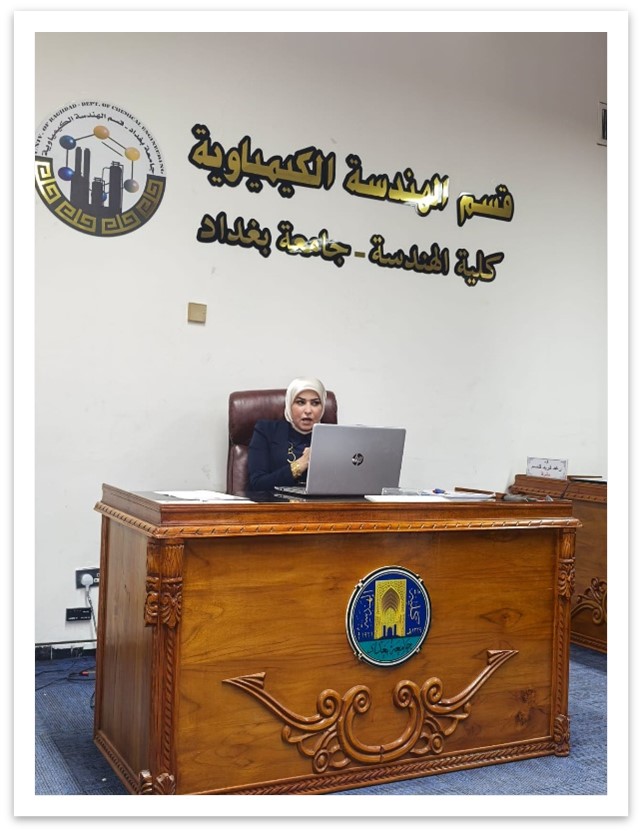
Under the patronage of the Dean of the College of Engineering, Professor Dr. Ghassan Hamid Abdul Majeed, and the supervision of the Head of the Department of Chemical Engineering, Professor Dr. Rasha Habib Salman, the Department of Chemical Engineering, in cooperation with the Continuing Education Unit, organized a scientific workshop entitled “Applications of Artificial Intelligence in Chemical Engineering.” The workshop was delivered by a group of distinguished faculty members from the department on Sunday, May 24, 2026, in Professor Dr. Mohammed Omar Hall, with the attendance of faculty members, researchers, and undergraduate and postgraduate students.
This workshop was organized as part of the department’s scientific activities aimed at enhancing knowledge of modern technologies and promoting their application in engineering fields, in line with the rapid advancements taking place worldwide in artificial intelligence and digital transformation.
The workshop highlighted the digital revolution driven by Artificial Intelligence (AI) and Machine Learning (ML) technologies in reshaping the future of the chemical and petroleum industries. It demonstrated how intelligent solutions can be utilized to improve industrial performance and enhance the efficiency of production processes.
The workshop also addressed the role of artificial intelligence in accelerating the discovery and design of new materials and catalysts, as well as optimizing the real-time operation of reactors and separation units while reducing energy consumption. These applications contribute to increased productivity and support sustainability goals.
In addition, the workshop reviewed predictive maintenance applications based on big data analytics in industrial plants and their role in forecasting equipment failures before they occur, thereby enhancing occupational safety standards and reducing operational costs. It also introduced the concept of Digital Twins and emphasized their importance in simulating industrial processes and improving the management and operational efficiency of chemical facilities.
The workshop concluded with a set of recommendations emphasizing the importance of raising awareness of artificial intelligence applications in chemical engineering, expanding related scientific research, and encouraging collaboration between academic institutions and the industrial sector. Such cooperation would facilitate the adoption of intelligent technologies to improve production processes and operational efficiency, enabling organizations to keep pace with rapid technological developments and support the requirements of sustainable development.