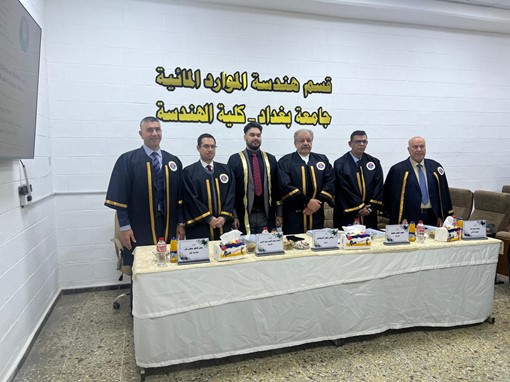
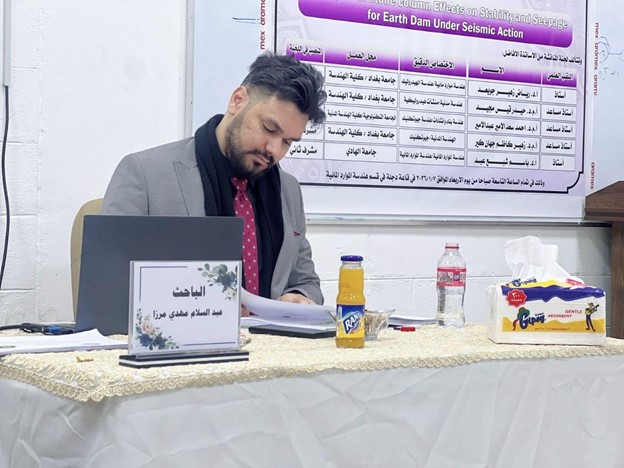
The College of Engineering at the University of Baghdad witnessed the public defense of the Master’s thesis submitted by graduate student Abdulsalam Mahdi Mirza from the Department of Water Resources Engineering, entitled:
“Effect of Using Stone Columns with Repeated Seismic Action on Stability and Seepage of an Earth Dam”
The defense took place on Wednesday, 7/1/2026, in Dijla Hall at the Department of Water Resources Engineering.
The examination committee was chaired by Prof. Dr. Riyadh Zuhair Jowaid, with the membership of Ass. Prof. Dr. Haider Qais Majid and Ass. Prof. Dr. Ahmed Saad Al-Ameer Abdulameer.
The thesis was supervised by First Supervisor: Ass. Prof. Dr. Zuhair Kazem Jahan Gir, and Second Supervisor: Prof. Dr. Basim Shaba Abdul.
Main Objectives of the Research:
- To study the effect of using stone columns on the stability and seepage behavior of earth dams.
- To conduct experimental tests using a seismic simulator device to evaluate the variation between experimental and theoretical model results.
- To investigate the effect of stone columns at different locations within the earth dam using the GeoStudio software.
- To evaluate the stability of Al-Adhaim Earth Dam under repeated seismic loading, with and without stone columns, using a numerical model.
Conclusions:
The results indicate that the stone column increased seepage discharge and exit hydraulic gradient due to its high permeability. The maximum increase was recorded in Case 4 (stone columns on both slopes) at the normal water level of 131.5 m above sea level, resulting in increases of 8.22% and 6.84%, respectively.
The presence of stone columns improved the factor of safety of both upstream and downstream slopes under all repeated seismic events. The presence of an upstream stone column did not affect the downstream factor of safety, and similarly, the presence of a downstream stone column did not affect the upstream factor of safety.
However, repeated seismic activity caused failure in the slopes of Al-Adhaim Earth Dam. The downstream slope failed after the third earthquake (0.15g), and the upstream slope failed after the fourth earthquake (0.2g), with both showing factors of safety less than 1. Although stone columns improved stability, they did not prevent failure. The upstream slope failed after the fourth earthquake (0.25g) and the downstream slope after the third earthquake (0.25g), despite the presence of a single stone column. Increasing the number of stone columns enhanced stability, particularly in Case 4.
Recommendations and Suggestions for Future Studies:
- To evaluate the accuracy of GeoStudio by comparing numerical modeling results with real earth dams subjected to earthquakes, such as settlement, deformation, or slope stability.
- To study the effect of stone columns on earth dam slope stability using three-dimensional analysis to realistically represent seismic wave propagation and its impact on the entire structure.
- To investigate the effect of stone columns on earth dam stability using different software programs such as PLAXIS, GEO5, and FLAC.
- To construct a large-scale physical earth dam model to study seismic effects and compare the results with numerical models.
- To study the effect of modern soil improvement techniques, such as micropiles or cement grouting, on the stability of earth dams.
- To investigate the impact of higher peak ground acceleration values, such as 0.30g, 0.35g, and 0.40g, on the stability of Al-Adhaim Earth Dam.