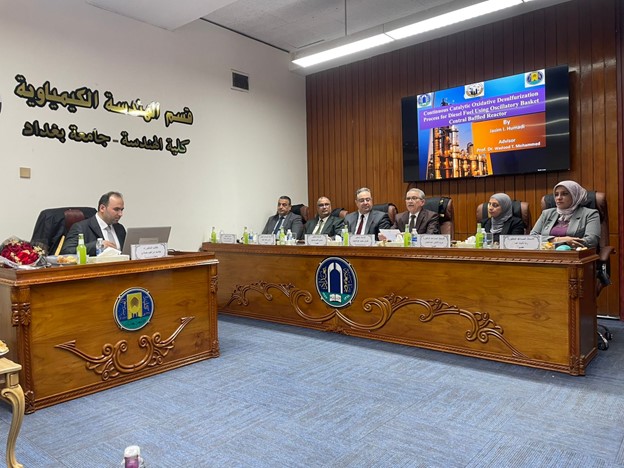
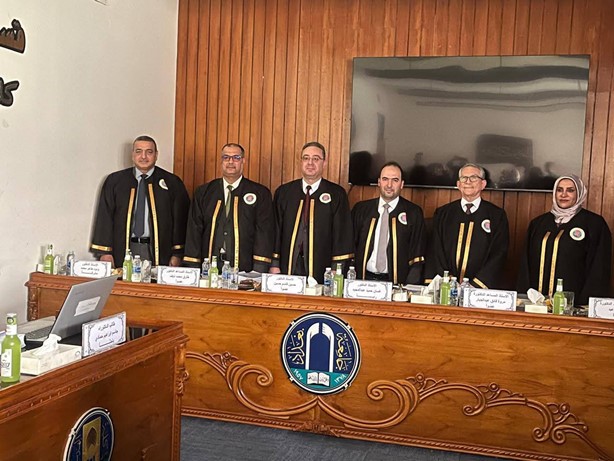
The Chemical Engineering Department at the College of Engineering, University of Baghdad, held a PhD dissertation examination titled:
Experimental Study and Machine Learning Modeling of Continuous Catalytic Oxidative Desulfurization for Diesel Fuel in an Oscillatory Basket Central Baffled Reactor
By the student “Jasim Ibrahim Humadi” and supervised by Prof. Dr. Wadood Taher Mohammed. The examination committee consisted of Prof. Dr. Ghassan H. Abdul-Majeed as Chairman and the membership of Prof. Dr. Hussein Q. Hussein, Asst. Prof. Dr. Rana Th. Abd Alrubaye, Asst. Prof. Dr. Marwa F. Abdul Jabbar, and Asst. Prof. Dr. Tariq M. Naife. The thesis was accepted after conducting a public discussion and listening to the student’s defense. The thesis was summarized as follows:
The aim of study:
This thesis aims to develop a novel approach for deep desulfurization of real and model diesel fuels using a newly designed Oscillatory Basket Central Baffled Reactor (OBCBR), addressing for the first time the challenge of handling solid catalysts in continuous oxidative desulfurization processes by packing a newly synthesized composite catalyst within the baskets of the reactor baffles, thereby enabling efficient, stable, and continuous reactor operation. The study includes the design, fabrication, and operation of the OBCBR through the construction of central basket baffles for packing solid catalyst particles, while ensuring ease of catalyst loading, unloading, and regeneration for oxidative desulfurization of real diesel (8281 ppm S) and model diesel (795 ppm DBT). It also involves the synthesis of uncoated activated carbon-based composite catalysts modified with iron–manganese oxides (5% MnO₂–X% Fe₂O₃/AC, X = 0–3), as well as the preparation of an alumina-coated catalyst [2% Al-(5% MnO₂–3% Fe₂O₃/AC)] for catalytic desulfurization reactions in the presence of hydrogen peroxide as an oxidizing agent. Furthermore, the effects of key operating variables, including oscillation frequency, oscillation amplitude, temperature, space time, and catalyst type, are investigated, along with reactor performance analysis based on oscillatory reactor dimensionless groups such as net flow Reynolds number (Ren), Strouhal number (St), oscillatory Reynolds number (Reo), and velocity ratio (Ψ). The kinetics of real diesel desulfurization using both coated and uncoated catalysts are evaluated based on experimental data, and the optimal kinetic parameters for dibenzothiophene (DBT) oxidation in model diesel are estimated using mathematical modeling via gPROMS. In addition, the performance of artificial intelligence and machine learning models, including Support Vector Machine and Gradient Boosting Machine, as well as artificial neural networks, is assessed in simulating desulfurization processes of real and model diesel fuels in the continuous oscillatory reactor under various operating conditions and catalyst types.
Abstract:
To meet stringent environmental regulations on sulfur content in fuels, oxidative desulfurization (ODS) has emerged as a promising alternative or complement to conventional hydrodesulfurization. This study focuses on developing a novel Oscillatory Basket Central Baffled Reactor (OBCBR) to overcome the challenge of handling solid catalysts by packing them within central baskets, enabling efficient and continuous deep desulfurization. Experiments were conducted on real diesel (8281 ppm S) and model diesel (795 ppm DBT) using hydrogen peroxide under mild operating conditions.
Composite catalysts based on activated carbon loaded with manganese and iron oxides and coated with alumina were synthesized via impregnation. Characterization confirmed successful preparation and enhanced catalytic performance due to increased active sites and improved surface properties, while the alumina layer ensured high stability. The results demonstrated very high desulfurization efficiency within short time, reaching 99.63% for real diesel and 98.11% for model diesel under optimal conditions, with performance improving at higher temperatures, oscillation conditions, and iron loading.
Dimensional analysis revealed that maximum efficiency was achieved at optimal operating groups, and comparison with laminar flow reactors confirmed that oscillatory mixing is the key factor in performance enhancement. The catalysts exhibited good stability and regeneration capability, particularly using iso-octane. Kinetic modeling using gPROMS showed strong agreement with experimental data and low activation energy, indicating efficient reaction behavior.
Artificial intelligence models, including Support Vector Machine, Gradient Boosting Machine, and artificial neural networks, were applied for the first time to simulate the ODS process, with GBM demonstrating the highest prediction accuracy. Overall, this work provides an energy-efficient and cost-effective approach for desulfurization and supports the development of smarter and more sustainable refining technologies.