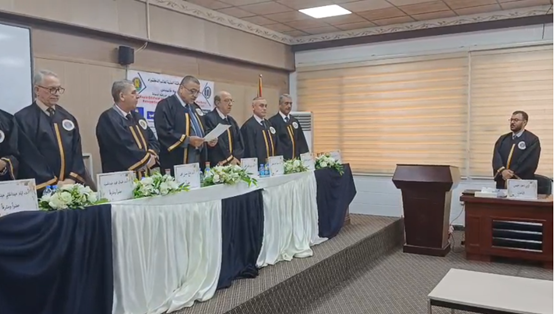
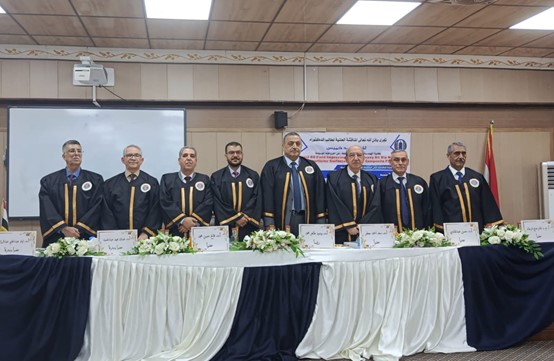
The Petroleum Engineering Department at the College of Engineering, University of Baghdad, held a PhD dissertation examination titled:
Improving the flow characteristics of East Baghdad heavy oil: An experimental study and ML modeling of a novel nanocomposite fluid
On Thursday, April 30, 2026, under the supervision of Prof. Dr. Ghassan Hameed Abdul-Majeed and Prof. Dr. Ayad A. Alhaleem A. Razzaq, the thesis was discussed by the following examination committee:
- Prof. Dr. Wadood Taher Mohammed
University of Baghdad / Al-Khwarizmi College of Engineering — Chairman - Prof. Dr. Falih Hassan Mohammed
University of Baghdad / College of Engineering — Member - Prof. Dr. Saad Ahmed Jafar
Al-Farabi University / College of Engineering — Member - Prof. Dr. Hassan Abdul-Hadi
University of Baghdad / College of Engineering — Member - Assist. Prof. Dr. Ghanim M. Farman
University of Baghdad / College of Engineering — Member - Prof. Dr. Ghassan H. Abdul-Majeed
University of Baghdad / College of Engineering — Supervisor - Prof. Dr. Ayad A. Alhaleem A. Razzaq
University of Baghdad / College of Engineering — Supervisor
Aim of the Thesis
This thesis aims to develop an effective method for improving the properties of East Baghdad heavy crude oil using nanotechnology and ultrasonic treatment.
The study focuses on reducing crude oil viscosity and improving its flowability through pipelines.
It also aims to increase API gravity in order to improve crude oil quality and economic value.
Another objective is to reduce the sulfur content of crude oil to minimize corrosion problems and environmental pollution.
The thesis also seeks to reduce the concentrations of heavy metals, particularly vanadium and nickel, due to their negative effects on refining processes.
The study includes the preparation of different kerosene-based nanofluids and their comparison to identify the most effective nanofluid.
It also investigates the effects of temperature and ultrasonic exposure time on the efficiency of crude oil upgrading.
Furthermore, the study evaluates the effect of treatment on crude oil transportation from the East Baghdad field to Al-Doura Refinery using pipeline simulation software.
Machine learning models are also applied to predict viscosity reduction and support the selection of optimum operating conditions.
Overall, the thesis aims to provide a technically and economically applicable solution for improving the transportation and refining of Iraqi heavy crude oil.
Abstract
This study investigated the improvement of East Baghdad heavy crude oil, which is characterized by a high viscosity of 58.15 cP, a low API gravity of 19.63°, and a high sulfur content of 4.422 wt.%, in addition to high concentrations of vanadium and nickel of 109.67 ppm and 42.65 ppm, respectively. These properties cause significant difficulties in pipeline transportation, increase energy consumption, and complicate refining operations.
The study adopted kerosene-based nanofluids prepared using different nanoparticles, including aluminum oxide, zirconium oxide, silicon dioxide, and iron oxide, combined with ultrasonic treatment at temperatures ranging from 20 to 75 °C and treatment times between 15 and 60 min. A surfactant was also used to improve nanoparticle dispersion and enhance treatment efficiency.
The results showed that the aluminum oxide-based nanofluid was the most effective among all tested nanofluids. Under the optimum conditions of 75 °C and 60 min, the viscosity decreased from 58.15 to 5.58 cP, corresponding to a reduction of approximately 90.4%. In addition, API gravity increased from 19.63° to about 30.49°. Vanadium concentration decreased to 9 ppm, nickel concentration decreased to 6.58 ppm, and sulfur content decreased to 0.77 wt.%.
To further improve sulfur removal, the concentrations of nanoparticles and surfactant were increased, and the treatment temperature was raised to 90 °C. The aluminum oxide-based system reduced sulfur content to 0.35 wt.%, while the zirconium oxide-based system reduced sulfur content to 0.40 wt.%, confirming the possibility of obtaining low-sulfur crude oil with a sulfur content below 0.5 wt.%.
The effect of upgrading on pipeline transportation was evaluated using pipeline simulation software. A pipeline of 40 km length and 12.75 in diameter, with a flow rate of 25,000 barrels per day, was simulated. The results showed that the required hydraulic power decreased from 72.4 to 42.5 kW, representing a reduction of 41.3%.
In addition, machine learning models were developed to predict viscosity reduction, including Artificial Neural Networks, Support Vector Regression, and K-Nearest Neighbors. The Support Vector Regression model achieved the best performance, with a coefficient of determination of 0.9733, a root mean square error of 1.95%, and a mean absolute error of 1.38%.
Overall, the study confirms that combining nanoparticles, particularly aluminum oxide, with kerosene, surfactant, and ultrasonic treatment represents an effective and promising approach for upgrading East Baghdad heavy crude oil. This approach significantly reduces viscosity, sulfur content, and heavy-metal concentrations, while improving transportability and reducing energy requirements.