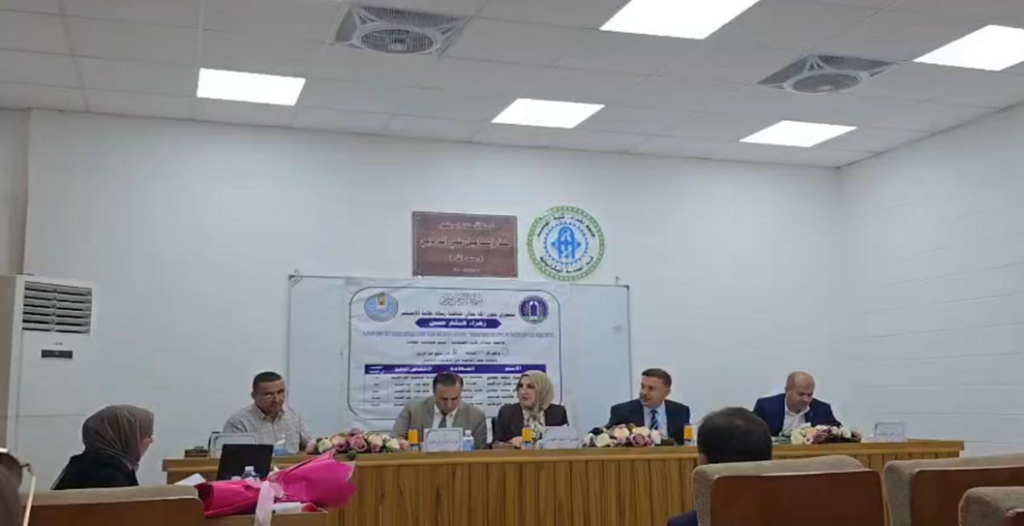
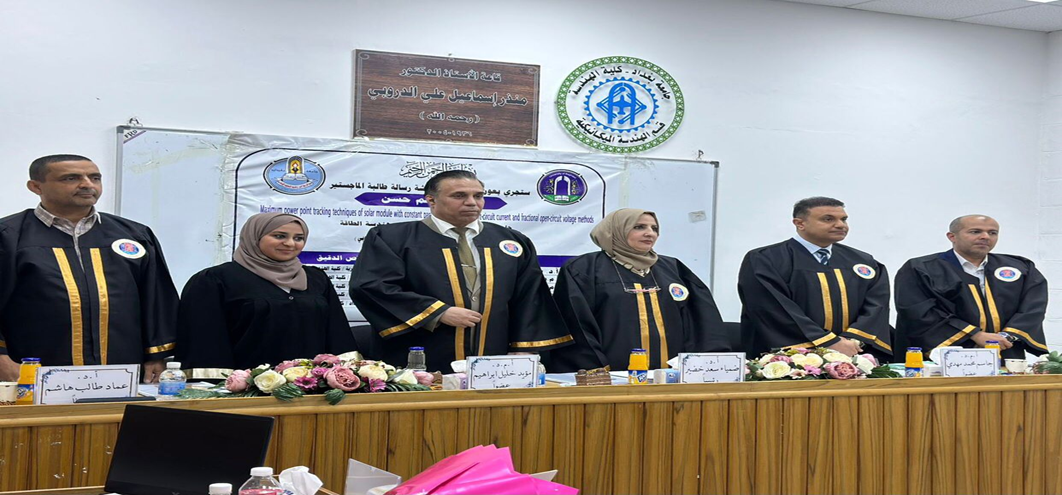
The College of Engineering at the University of Baghdad witnessed the public discussion of the master’s student Zahraa Haitham Hassan in the Department of Energy Engineering about her thesis entitled:
“Maximum Power Point Tracking Techniques for a Solar Module with Constant Parameters: The Partial Short-Circuit Current Method and the Partial Open-Circuit Voltage Method”
That was on Thursday 30/4/2026, in Dr. Munther Al-Daroubi Hall in the Mechanical Department, under the supervision of both Prof. Dr. Imad Talib Hashim and Asst. Prof.Dr. Yasser Al-abdulwahab..
In this research, the performance of a perovskite solar panel was studied under the effect of solar radiation and temperature using the partial short-circuit current method and the open-circuit voltage method to track the maximum power point (MPPT).
The experiments were conducted in the field at the College of Engineering – University of Baghdad for the period from January 2025 to May 2025 using the Prova device.
The results showed an increase in output power with an increase in solar radiation, reaching 446.2 W at 1000 W/m², while the rise in temperature led to a decrease in voltage and efficiency.
The best efficiency was recorded at 25°C, reaching 10.7%.
The study proved the efficiency of the partial short-circuit current method and the partial open-circuit voltage method under changing weather conditions.
After the results, the researcher recommended the following:
1 – Conducting more comprehensive studies on the effects of different environmental conditions on the performance of solar energy systems and energy maximization, including factors such as humidity, dust accumulation, shading, soiling, and wind speed.
2 – To determine the most theoretically efficient methods and maximize their performance, develop maximum power point tracking (MPPT) algorithms and model them using Simulink or similar platforms.
3 – Using the same MPPT technique, compare the current-voltage (I-V) and power-voltage (P-V) characteristic curves for different types of solar modules, including first-generation (crystalline silicon) and second-generation (thin-film) technologies.
After the public discussion by the respected members of the discussion committee and listening to the researcher’s defense and evaluating the thesis, the researcher obtained a master’s degree in Energy Engineering with a grade of Very Good.