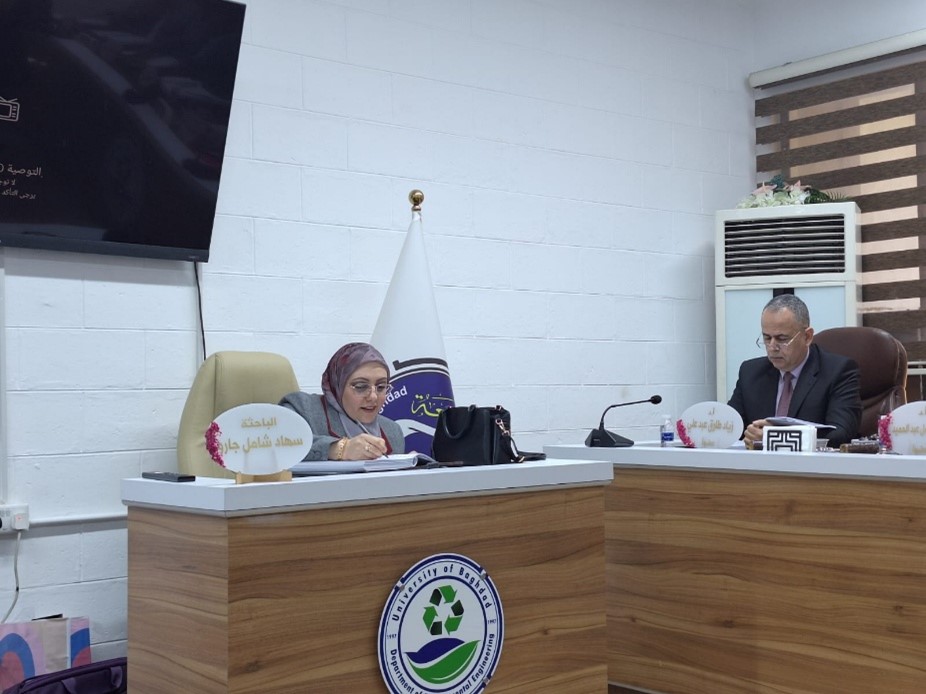

The Dean of the College of Engineering at University of Baghdad, Prof. Dr. Ghassan Hamid Abdulmajeed, chaired on Sunday, February 15, 2025, the PhD dissertation defense committee of the student Suhad Shamil Jaro Abdul Rahman from the Department of Environmental Engineering. Her dissertation, entitled “Evaluation of the Effectiveness of a Biofuel System in Treating Wastewater and Saline Water,” was held in the department’s discussion hall under the supervision of Prof. Dr. Muhannad Jassim Mohammed Redha, and with the membership of Prof. Dr. Ziyad Tariq Abdul Ali, Assistant Dean for Scientific Affairs and Graduate Studies.
The study aimed to develop an integrated system that combines wastewater treatment, saline water desalination, and electricity generation through the utilization of photosynthetic microbial desalination cells with an algal cathode, contributing to sustainable solutions for water and energy scarcity.
The dissertation presented the design of an advanced five-chamber system compared to the conventional three-chamber configuration. Two operational setups were examined: a double-anode photosynthetic microbial desalination cell (DADPMDC) with cylindrical graphite electrodes, and a microbial reverse electrodialysis cell (MREC) with rectangular graphite electrodes. The results demonstrated high efficiency in removing Chemical Oxygen Demand (COD), reducing Total Dissolved Solids (TDS), and eliminating metal ions. The system also achieved advanced nitrate and phosphate removal rates and successfully generated electrical power. Additionally, it proved effective in cultivating microalgae species Chroococcus and Scenedesmus with notable efficiency.
The findings confirmed that the proposed system represents a promising option for treating industrial wastewater and desalinating saline and brackish groundwater while simultaneously producing clean energy and biomass that can be utilized as biofuel.
The study recommended further investigation into the use of different membrane types and surface areas, the adoption of alternative microorganisms capable of supplying oxygen in the cathode chamber, and exploring mechanisms to reduce membrane fouling and restore membrane performance. It also suggested employing artificial intelligence algorithms to optimize operational efficiency, control salinity levels, and maximize energy production.
At the conclusion of the defense, the student was awarded the PhD degree in Environmental Engineering. The examination committee commended the scientific effort and the significance of the results, affirming that the study represents a valuable contribution to the field of sustainable environmental treatment technologies.