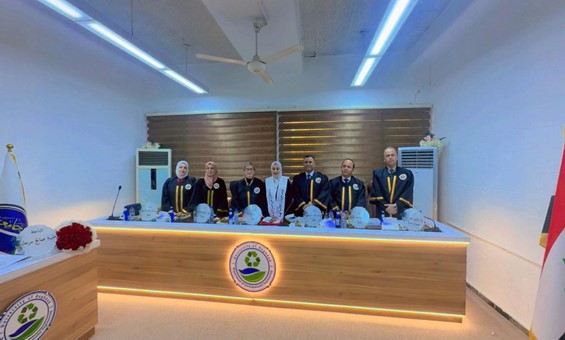
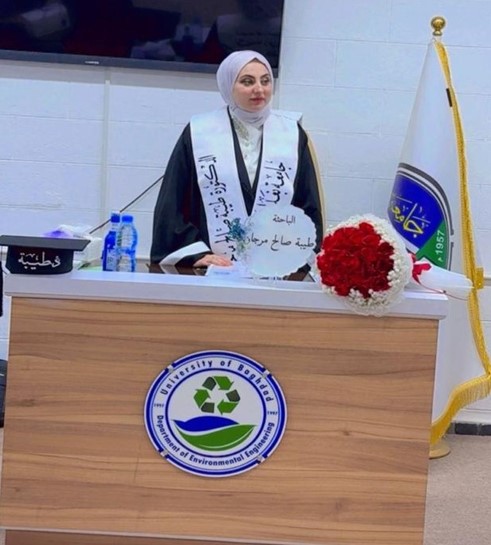
Environmental Engineering Department at the College of Engineering, University of Baghdad, held PhD dissertation examination titled:
“Green approach for fabrication of immobilized multi-metallic nanoparticles for removal of lead ions and cefixime antibiotic from aqueous”
By the student (Teeba Salih Hadi Merjan) and supervised by Prof. Dr. Ziad Tariq Abid Ali on Sunday 23/11/2025, in the Environmental Engineering discussion Hall. The examination committee consisted of Prof. Dr. Zainab Ziad Ismail as Chairman, and the membership of Prof. Dr. Abeer Ibraheem Musa, Assistant Prof. Dr. Basim Hameed Jraimed, Assistant Prof. Dr. Mohammed Bahjet Abdul-kareem and Assistant Prof. Dr. Noor Alaa Abdul-Hussain. After conducting the public discussion and listening to the student’s defense, the dissertation was accepted. It was summarized as follows:
Preserving an uncontaminated and ecologically balanced environment is a critical prerequisite for the health and survival of all life forms, necessitating the integration of environmentally benign technologies that mitigate ecological degradation and promote long-term sustainability. In this context, the present investigation adopts a sustainable nanotechnological strategy aimed at enhancing pollution control and environmental restoration. Specifically, the study investigates the synthesis of trimetallic (Fe/Cd/Cu) and bimetallic (Fe/Cd) nanoparticles immobilized onto inert glass waste (GW) as a solid-supported matrix, producing the nanocomposite systems GW-Fe/Cd/Cu and GW-Fe/Cd. These engineered materials are systematically used for removing lead ions (Pb(II)) and the pharmaceutical pollutant cefixime (CEF) from aqueous media. In line with green chemistry principles, a naturally derived plant extract was used in the synthesis process of nanoparticles as a reducing and antioxidant agent, the type and amount of green extract, pH, molar ratio of metallic nanoparticles, and amount of glass granules, were optimized to improve the nanocomposites’ performance. The synthesized nanocomposites were thoroughly characterized using SEM, EDX, TEM, FTIR, XRD, and surface area analysis, confirming the successful immobilization of metallic nanoparticles onto the glass surface with desirable structural and morphological properties. The adsorption efficiency of the synthesized nanocomposites was assessed under both batch and continuous experimental conditions. Batch experiments investigated the influence of contact time, pH, agitation speed, initial amount and dosage. These parameters were optimized to achieve the highest removal efficiency for Pb(II) (96% and 90%) and CEF (95% and 89%), for trimetallic and bimetallic nanocomposites, respectively. The optimal removal conditions for Pb(II) were [(80 and 100 min), (6), (200rpm), (50mg/L), and (0.8 and 1g/100mL)], while for the removal of CEF were: [(80 and 120 min), (11), (200 rpm), (50mg/L), and (0.8 and 1g/100mL)] for trimetallic and bimetallic systems, respectively. Kinetic and equilibrium adsorption analyses revealed that the sequestration of Pb)II) and CEF by nanocomposites GW-Fe/Cd/Cu and GW-Fe/Cd conformed to the isotherm of the Freundlich and the kinetic model 2nd-pseudo-order. Continuous flow column experiments were conducted to evaluate the system under realistic conditions, examining parameters such as initial contaminant concentration, flowrate, bed height, and hydraulic conductivity. The nanocomposites significantly delayed the migration of Pb(II) and CEF, with stronger retardation observed for Pb(II). Additionally, a one-dimensional steady-state contaminant transport model has been solved and developed utilizing COMSOL Multiphysics; the resulting COMSOL data from the solution of the contaminant transport model aligned well with the experimental results. Overall, the green-synthesized trimetallic nano (GW-Fe/Cd/Cu) showed better performance than the bimetallic nano (GW-Fe/Cd). This study emphasizes the potential of green-synthesized nanomaterials as sustainable and effective options for environmental remediation.
The following suggestions are provided for future research to enhance the understanding and application of nanocomposites in water treatment:
- Reinforcing sustainable development through using eco-friendly, abundant, and low-cost by-product wastes as reactive materials in the removal of contaminants from contaminated water.
- Promoting the circular economy in water remediation by transforming waste into resources that can be employed for this purpose, and designing recyclable and regenerative reactive materials.
- Advancing green methodologies, biodegradable, and bio-compatible materials through applying microbial and enzymatic systems to degrade or transform contaminants in water without harmful residues.
- Study the migration of contaminants within two-dimensional or three-dimensional reactive beds, and advance the modeling techniques, such as computational fluid dynamics (CFD), to enhance understanding of migration pathways and optimize bed design.