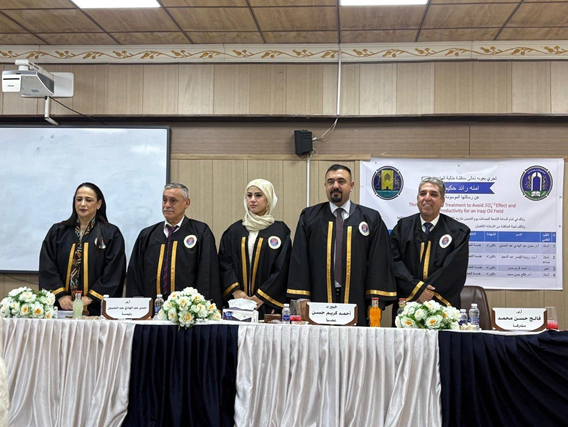
The College of Engineering at the University of Baghdad held the public defense of the Master’s thesis submitted by researcher Amna Raed Hakim Al-Duhaibawi, from the Department of Petroleum Engineering. The thesis, entitled “Evaluation of Reverse Osmosis Treatment and Scale Inhibitor Treatment to Improve Injectivity and Reduce Formation Damage in Carbonate Reservoirs,” was defended on Thursday, August 20, 2026, in the Graduate Studies Hall of the Department of Petroleum Engineering, under the supervision of Prof. Dr. Falah Hassan Mohammed Al-Mahdawi.
The study aimed to evaluate the suitability of Third River water as a potential source for injection water and to investigate the effect of water treatment on improving injectivity and reducing formation damage in carbonate reservoirs. The research compared the performance of untreated water with water treated using a Reverse Osmosis (RO) system and water treated with the phosphonate scale inhibitor DTPMP. Laboratory core-flooding experiments were conducted using carbonate core samples from the Mishrif Formation in the West Qurna-1 Field. The experiments evaluated changes in pressure differential, permeability, and injectivity, in addition to investigating the properties of the water and rock and their interactions.
The results demonstrated the effectiveness of reverse osmosis treatment in improving the quality of Third River water. The sulfate concentration decreased from 2,130 ppm to 6 ppm, representing a removal efficiency of approximately 99.7%, while the total dissolved solids (TDS) decreased from 6,510 ppm to 1,100 ppm. The injection experiments showed that untreated water generally resulted in higher pressure differentials and greater permeability reduction. In contrast, RO-treated water exhibited more stable behavior and an overall improvement in injectivity. The use of the DTPMP scale inhibitor also improved injection performance compared with untreated water, although the response varied among the core samples investigated.
Following an extensive study, the thesis concluded with a number of recommendations. The most important recommendations included expanding investigations into the performance of injection-water treatment techniques using a larger number of core samples to better represent the heterogeneity of reservoir properties. The study also recommended conducting additional analyses after the injection experiments to determine the nature and locations of deposits within the porous medium. Furthermore, evaluating different concentrations of scale inhibitors and investigating their efficiency under various reservoir conditions were recommended. Such efforts would contribute to improving injectivity and minimizing formation damage in carbonate reservoirs.
Following the scientific discussion, the researcher’s defense, and the evaluation of the thesis by the members of the examination committee, the researcher was awarded a Master’s degree in Petroleum Engineering.


