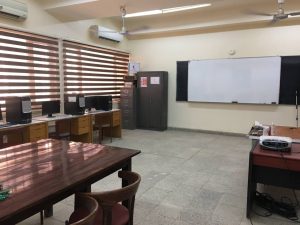
Learning through practical engineering
Explore the laboratories and practical learning opportunities in Computer Engineering.
Networks Laboratory
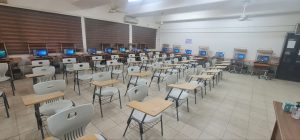
This laboratory supports practical work in computer networks, internet technologies, digital control systems, and website programming. Experiments and guided applications help students build foundational knowledge and apply engineering concepts to real technical tasks.
Laboratory activities serve students in the second, third, and fourth academic stages and develop skills relevant to network operation, website development, and digital control systems.
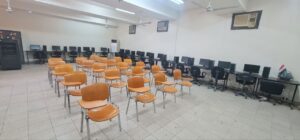
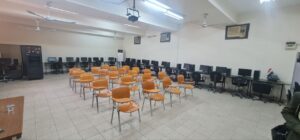
Wireless Networks Laboratory
The laboratory provides practical activities in programming, data structures, databases, digital-system design, and microprocessor applications. It is also used for departmental lectures, seminars, and workshops.
Vision
To connect theoretical learning with practical applications and keep laboratory curricula aligned with developments in teaching and technology.
Mission
To provide structured, high-quality applied learning that strengthens students’ ability to build systems, design algorithms, and apply their knowledge in professional settings.
Objective
To develop practical skills through suitable equipment and software, preparing students for work in computer-related fields.


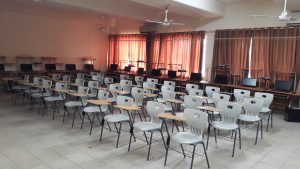
Electronics and Communications Laboratory
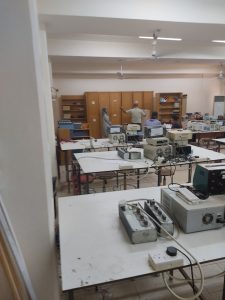
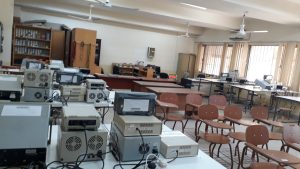
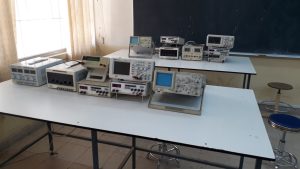
The laboratory introduces students to electronic and communication circuits and their applications through practical experiments and equipment-based learning.
Learning objectives
- Build a strong foundation for advanced study and professional development in electronics and communications.
- Identify and troubleshoot faults in electronic circuits and communication systems.
- Understand diodes, transistors, operational amplifiers, and modern laboratory technologies.
- Design and analyze analog communication systems, including AM and FM modulation, detection, and spectrum analysis.
- Understand analog-to-digital communication and techniques such as sampling, PCM, and Delta Modulation.
Microprocessor Laboratory
Students conduct experiments in interfacing input and output devices with microprocessors and write programs for device control. The laboratory uses an educational system based on the 8086 microprocessor, experimental models, and computers.
Vision
To graduate engineers with in-depth knowledge of microprocessor-based systems.
Mission
To prepare graduates with the knowledge and expertise to design and work with microprocessor-based systems.
Learning objectives
- Design microprocessor systems that interact with their environment through input and output devices.
- Understand the components and operation of microprocessor systems.
- Interface input and output devices and develop programs to control them.
Basics of Digital Systems Laboratory
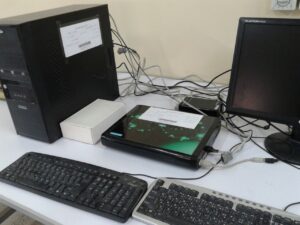
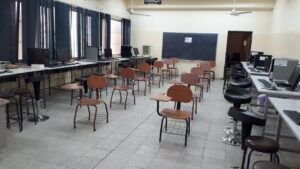
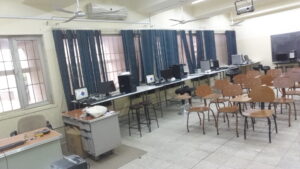
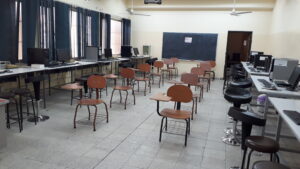
This laboratory provides foundational practical experiments for first-year undergraduate students across two semesters. Activities complement coursework in digital and logic circuits and establish concepts used in digital systems, control, data communications, computing, programming, and signal processing.
Learning objectives
- Perform arithmetic operations in different number systems.
- Apply Boolean algebra and simplify expressions using Karnaugh maps.
- Implement logical functions and design combinational circuits.
- Understand flip-flops and state-diagram representations of sequential circuits.
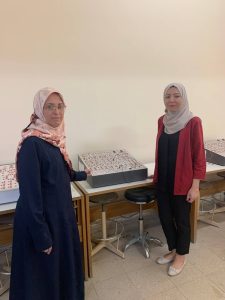
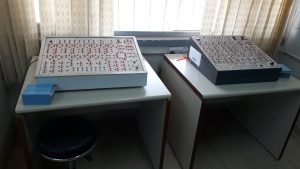

Computer Systems Basics Laboratory
Vision
To provide an up-to-date educational program that develops the capabilities of computer engineering graduates and supports excellence in engineering laboratory sciences.
Mission
To provide a disciplined learning environment that prepares graduates academically, professionally, ethically, and in research, enabling them to diagnose engineering problems and contribute to community development.
Learning objectives
- Develop practical skills in computer assembly and hardware and software troubleshooting.
- Prepare students to work effectively in engineering and public-service settings.
- Promote professional ethics and safe laboratory practices.
- Encourage collaboration with academic and professional institutions.